Global energy markets are entering a period of structural transformation. Rising geopolitical tensions, including the ongoing Iran oil conflict and broader instability across fossil fuel supply chains, are once again exposing the vulnerability of traditional energy dependence. Governments and energy companies worldwide are accelerating investments in renewable infrastructure to strengthen energy security and reduce exposure to oil volatility.
Wind energy is emerging as one of the fastest scaling sectors in this transition.
But while demand for wind turbines continues to surge, manufacturers face a difficult challenge: increasing production capacity without compromising blade quality.
Modern wind turbine blades are becoming significantly larger, more complex, and more expensive to manufacture. A quality deviation discovered late in the production cycle can now result in substantial material waste, production delays, costly rework, or complete blade rejection. For manufacturers operating under tight delivery timelines and growing order books, the margin for error is shrinking rapidly.
This shift is forcing manufacturers to rethink traditional production systems and invest in technologies that improve both speed and precision simultaneously.
That is precisely why more manufacturers are adopting AI vision for wind blade inspection alongside wind blade layup using laser projection to create a more intelligent and scalable Composite Layup Automation environment.
The goal is no longer simply detecting defects after production.
The focus is now on preventing defects during production itself.
Why Wind Blade Manufacturing Quality Has Become More Critical Than Ever
Wind blade manufacturing quality directly impacts:
- structural reliability,
- aerodynamic performance,
- operational lifespan,
- transportation durability,
- and maintenance costs.
As global wind energy deployment accelerates, manufacturers are under growing pressure to scale production capacity rapidly while maintaining increasingly stringent quality expectations.
At the same time, blade designs are becoming larger, more complex, and more material intensive. Offshore blades are now crossing 100 meters in length, with tighter structural tolerances and significantly higher production risk exposure. In this environment, maintaining manufacturing precision consistently across large composite structures is becoming increasingly difficult using conventional production methods alone.
Even small inconsistencies in composite layup can create significant downstream risks.
What makes the challenge more complex is that manufacturers are now expected to achieve:
- higher throughput,
- lower defect rates,
- faster production cycles,
- and improved traceability simultaneously.
This is precisely why achieving critical quality metrics is becoming increasingly dependent on advanced manufacturing technologies such as AI vision for wind blade inspection, CAD integrated workflows, and wind blade layup using laser projection.
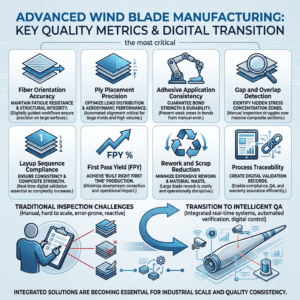
The most critical wind blade manufacturing quality metrics now include:
Fiber Orientation Accuracy
Incorrect fiber direction reduces fatigue resistance and weakens structural integrity. As blade dimensions increase, maintaining precise fiber orientation consistently across large layup surfaces becomes significantly more challenging without digitally guided workflows and automated verification.
Ply Placement Precision
Misaligned plies affect load distribution and aerodynamic performance. High production volumes and larger molds make manual alignment increasingly difficult to sustain with repeatable accuracy.
Adhesive Application Consistency
Uneven adhesive application compromises bond strength and structural durability. With rising production speed expectations, maintaining adhesive precision manually becomes more error prone.
Gap and Overlap Detection
Undetected gaps or overlaps can introduce hidden stress concentration zones. These deviations are often difficult to identify reliably through manual inspection alone, particularly across large composite sections.
Layup Sequence Compliance
Incorrect sequencing during composite stacking creates structural inconsistencies. As manufacturing complexity increases, real time digital process validation is becoming essential to ensure compliance across every production stage.
First Pass Yield
Manufacturers are under pressure to achieve built right first time production with minimal downstream correction. Rework at modern blade scales creates substantial operational and financial impact.
Rework and Scrap Reduction
Large composite blade rework is expensive, time intensive, and operationally disruptive. As material costs and production demand rise, manufacturers are prioritizing technologies that prevent defects before they propagate downstream.
Process Traceability
Manufacturers increasingly require digital validation records for quality assurance, compliance, and warranty assurance. Traditional manual documentation methods are becoming difficult to scale efficiently alongside rising production volumes.
Traditional inspection methods struggle to consistently maintain these quality metrics at industrial scale, which is why manufacturers are increasingly transitioning toward intelligent, real time quality assurance systems integrated directly into the production workflow.
Why Conventional Blade Manufacturing Methods Are Reaching Their Limits
Historically, composite layup processes have relied heavily on:
- physical templates,
- manual interpretation,
- operator expertise,
- and end of line inspection.
This approach creates multiple production bottlenecks.
Physical templates slow down workflows and require constant handling. Manual interpretation introduces variability between operators. Most importantly, defects are often discovered too late in the manufacturing cycle.
For modern wind blade production, late stage quality detection creates enormous consequences.
A single defect discovered after complete layup or curing may require:
- extensive rework,
- material replacement,
- schedule delays,
- or complete rejection of the blade section.
As blade dimensions increase, defect costs increase proportionally.
Manufacturers can no longer rely solely on reactive quality systems.
This is driving rapid adoption of intelligent production technologies that combine digital guidance with real time process validation. Manufacturers are increasingly realizing that offline QC is failing modern blade manufacturing because the industry can no longer afford delayed quality feedback loops.
How Wind Blade Layup Using Laser Projection Improves Manufacturing Precision
Laser projection systems from providers such as LAP, Z-Laser, and Assembly Guidance are becoming increasingly common across advanced composite manufacturing facilities.
These systems project the exact ply outlines, boundaries, alignment references, and fiber orientation instructions directly onto the mold surface using CAD integrated digital data.
This eliminates dependency on physical templates and significantly improves operator guidance during manual layup.
Precision and Quality Control
Laser systems project highly accurate ply geometries directly onto the mold, helping operators place composite materials exactly as intended within CAD specifications.
This improves:
- ply placement consistency,
- alignment precision,
- and fiber orientation accuracy.
Faster Composite Layup Operations
By replacing manual template positioning and measurement steps, laser projection significantly accelerates the layup process.
Operators spend less time interpreting drawings and more time executing production tasks.
Reduced Setup Complexity
Digital projection removes the repetitive preparation associated with physical templates, especially beneficial for large blade molds.
Multitasking Capabilities Across Large Molds
Modern laser projection systems support multiple teams working simultaneously on different sections of the same blade mold.
This parallel workflow capability is particularly valuable for manufacturing long blade segments where production efficiency is critical.
Workforce Scalability
Laser guided workflows simplify operator training and reduce dependency on highly specialized manual expertise.
However, despite these advantages, wind blade layup using laser projection still has a critical limitation.
Laser systems provide guidance.
They do not independently verify whether the operator actually followed the projected instructions correctly.
This is where AI vision for wind blade inspection fundamentally changes the manufacturing process.
Why AI Vision for Wind Blade Inspection Is Becoming Essential
AI vision for wind blade inspection introduces continuous manufacturing intelligence directly into the production workflow.
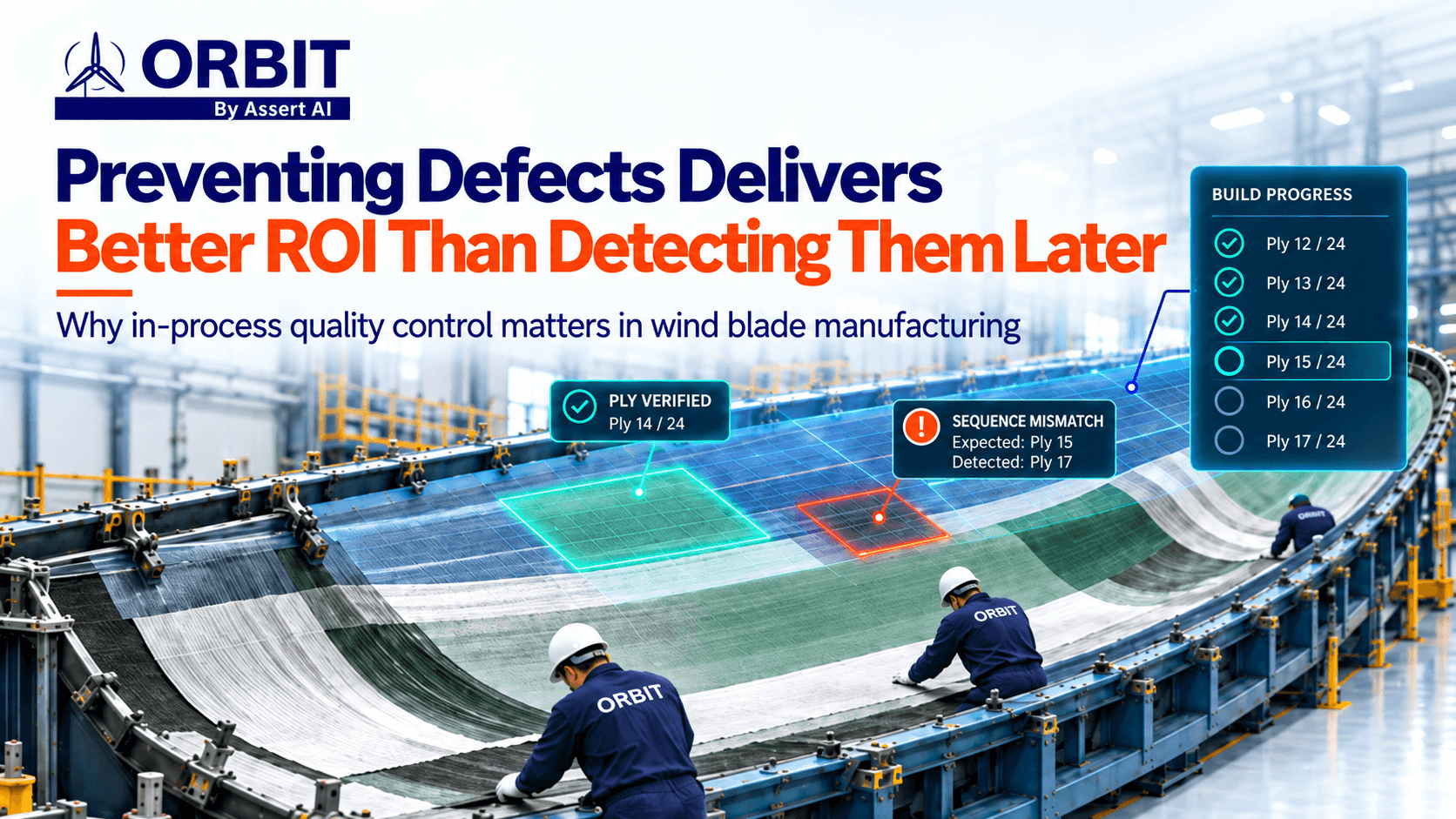
Instead of only guiding workers, computer vision continuously validates whether the manual layup has been executed correctly in real time.
This transforms composite manufacturing from an open loop process into a closed loop quality controlled environment.
What AI Vision Verifies in Real Time
Computer vision systems can continuously inspect:
- ply placement accuracy,
- fiber orientation,
- material overlaps,
- gaps between plies,
- missing layers,
- adhesive application,
- layup boundary deviations,
- foreign object presence,
- and sequence compliance.
Unlike conventional inspection systems, AI vision identifies deviations immediately during production instead of after blade completion.
Solutions like ORBIT’s AI powered composite layup monitoring platform are enabling manufacturers to combine real time inspection with process validation to improve first pass yield and reduce manual dependency across blade manufacturing operations.
How AI Vision and Laser Projection Work Together
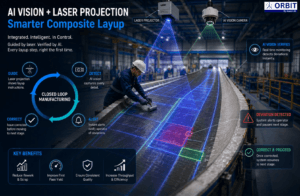
The real breakthrough happens when laser projection and AI vision operate as an integrated manufacturing system.
Laser projection guides the operator.
Computer vision verifies execution.
If the operator deviates from the projected layup instructions, the AI system:
- immediately detects the error,
- alerts the worker in real time,
- stops laser projection for the next manufacturing stage until the issue is corrected.
This creates true Composite Layup Automation.
Instead of depending only on downstream inspection, manufacturers gain continuous in process quality assurance that helps ensure every layup step is executed correctly the first time.
This closed loop manufacturing approach directly results in significant reduction in rework, rejection rates, material scrap, process variability, and costly downstream defects.
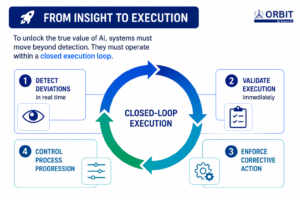
At the same time, manufacturers improve:
- first pass yield,
- process repeatability,
- quality consistency,
- and overall production throughput.
Why Defect Prevention Matters More Than Defect Detection
In large composite manufacturing, prevention is significantly more valuable than correction.
A defect detected after curing may require:
- destructive rework,
- material replacement,
- additional labor,
- production downtime,
- and delayed deliveries.
AI vision changes this dynamic entirely.
By validating every stage during execution, manufacturers can prevent defects before they propagate into expensive downstream failures.
This shift from reactive inspection to proactive manufacturing intelligence is one of the biggest reasons wind blade manufacturers are investing aggressively in AI driven quality systems.
The value is not only better inspection. The value is achieving built right first time manufacturing. Manufacturers are increasingly focused on eliminating hidden risks in manual composite layup because even minor layup deviations can become long term structural weaknesses in large blades.
How These Technologies Improve Both Quality and Production Efficiency
There is a misconception that advanced quality systems slow down production.
In reality, integrated laser and AI vision systems improve both quality and operational efficiency simultaneously.
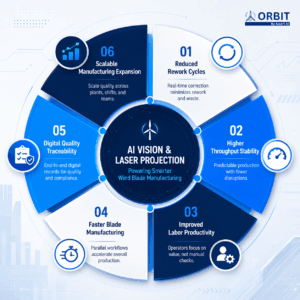
Reduced Rework Cycles
Real time correction eliminates downstream repair processes.
Higher Throughput Stability
Manufacturers achieve more predictable production planning with fewer interruptions.
Improved Labor Productivity
Operators spend less time manually checking layouts or correcting completed work.
Faster Blade Manufacturing
Parallel workflows across large molds improve production speed significantly.
Digital Quality Traceability
Every production step can be digitally recorded for compliance, warranty validation, and process optimization.
Scalable Manufacturing Expansion
Facilities can scale production while maintaining standardized quality across shifts, plants, and operator teams.
Why Wind Blade Manufacturing Leaders Are Investing Now
The renewable energy industry is entering a scale driven growth phase.
Manufacturers are under pressure to increase production capacity, reduce delivery timelines, maintain stricter quality standards, and improve operational efficiency simultaneously. At the same time, blade complexity continues increasing. Traditional manufacturing approaches are struggling to support this scale economically.
This is why leading manufacturers are upgrading toward:
- AI driven inspection systems,
- CAD integrated production workflows,
- laser guided composite layup,
- and real time manufacturing intelligence platforms.
The objective is clear: produce larger blades faster without compromising wind blade manufacturing quality. This broader transition toward AI driven wind turbine blade quality management reflects how manufacturers are increasingly prioritizing predictive quality systems instead of reactive inspection models.
The Future of Wind Blade Manufacturing Is Real Time, Intelligent, and Preventive
The next generation of wind blade manufacturing will not be defined only by production capacity. It will be defined by how effectively manufacturers can achieve precision, repeatability, and first pass quality at industrial scale.
Laser projection systems have already transformed operator guidance during composite layup. But when combined with AI vision for wind blade inspection, manufacturers move beyond guidance into true process verification and defect prevention.
This shift is also driving wider adoption of AI vision in composite manufacturing where manufacturers are replacing delayed inspection processes with continuous, real time quality assurance.
With integrated AI vision and laser guided Composite Layup Automation platforms like ORBIT, manufacturers can expect:
- real time detection and correction of layup deviations before continuation,
- up to 95 to 100% process visibility across layup and resin infusion operations,
- significant reduction in uncontrolled manual execution,
- AI assisted validation for faster and more reliable production,
- and stronger first pass yield performance with lower rework dependency.
The result is a shift from reactive quality inspection to controlled, intelligence driven manufacturing.
For production leaders scaling blade manufacturing capacity, the opportunity is no longer just faster production. It is producing larger, more complex blades with greater consistency, traceability, and confidence.
Ready to Eliminate Hidden Layup Defects Before They Become Expensive Rework?
Discover how ORBIT combines AI vision for wind blade inspection with wind blade layup using laser projection to improve process control, strengthen first pass quality, and enable smarter composite layup automation at scale.
👉 See How Leading Manufacturers Are Preventing Blade Defects in Real Time