Why is quality consistency still a challenge in advanced composite manufacturing?
Despite decades of process refinement, quality consistency remains one of the hardest problems in composite manufacturing. Even in highly automated environments, small execution variations during layup, infusion, or curing can quietly accumulate; only to surface later as rework, performance deviation, or audit friction.
This is where AI for manufacturing quality control enters the conversation- not as a replacement for engineering judgment, but as a way to bring objective, continuous verification into processes that have traditionally relied on post-fact inspection and operator expertise.
For manufacturers navigating increasing blade sizes, tighter certification demands, and shrinking margins, the question is no longer if quality needs to be digitized, but how to do it without disrupting production reality.
What does AI really change in manufacturing quality control for composites?
In composite manufacturing, AI doesn’t “inspect faster.”
It changes when and where quality is enforced.
Traditional quality control often happens after a ply is placed, a layup is completed, or a part is cured. AI shifts quality control into the execution window itself- when correction is still possible.
Here’s what that looks like in practice:
- Real-time execution verification
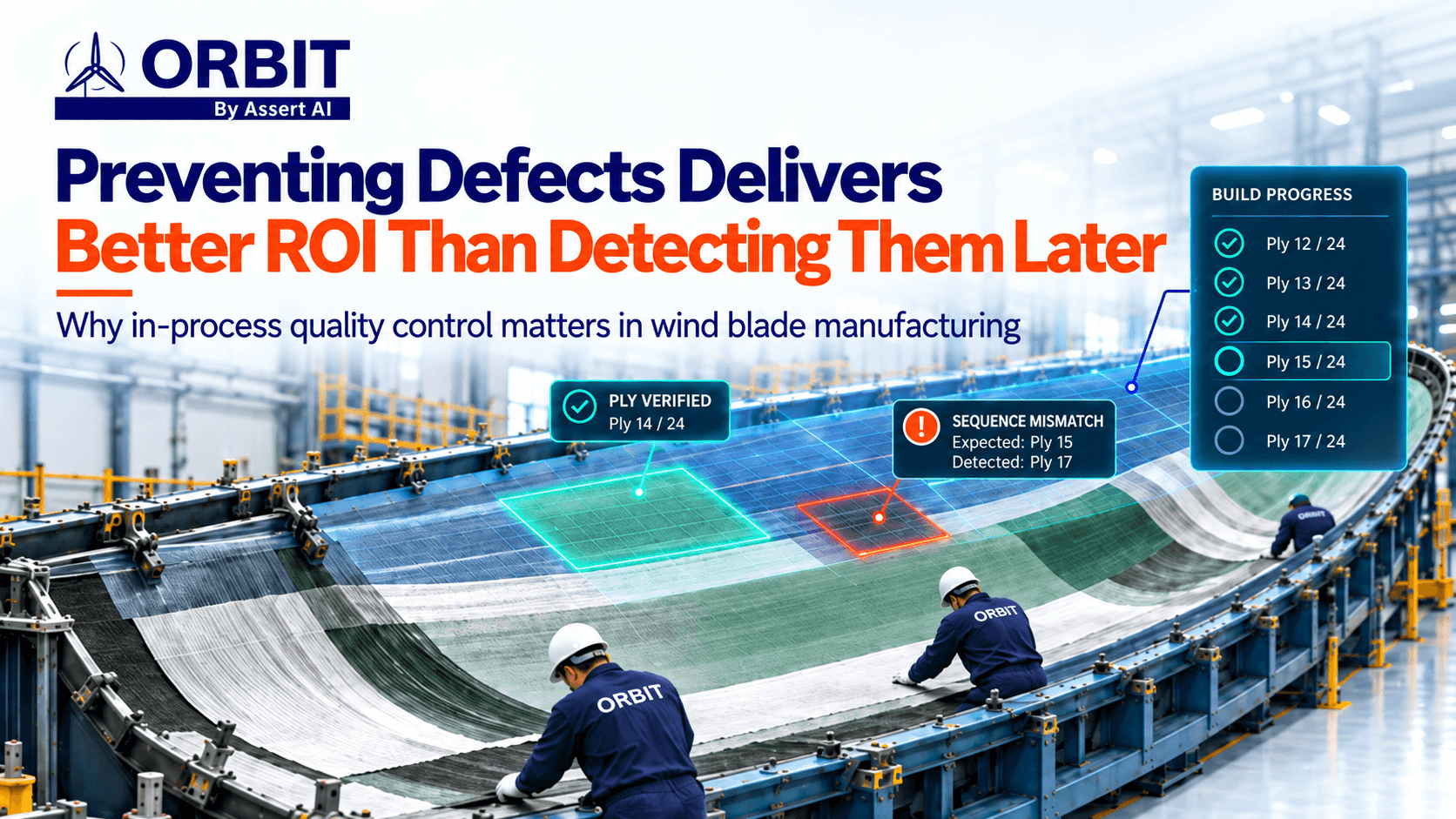
Ply orientation, sequence, overlap, and placement are verified as they happen, not hours later.
- Pattern recognition across builds
Subtle deviations across blades, molds, or shifts become visible long before they cross tolerance limits.
- Reduced operator fatigue dependency
AI acts as a second set of eyes during long, repetitive layups involving hundreds of plies.
- Root-cause visibility, not just defect counts
Quality issues are linked back to where and when execution drifted.
This is the operational shift that separates AI for quality control from traditional inspection tools.
How does AI improve defect detection and FPY in real composite manufacturing environments?
Step 1: Data capture on the shop floor
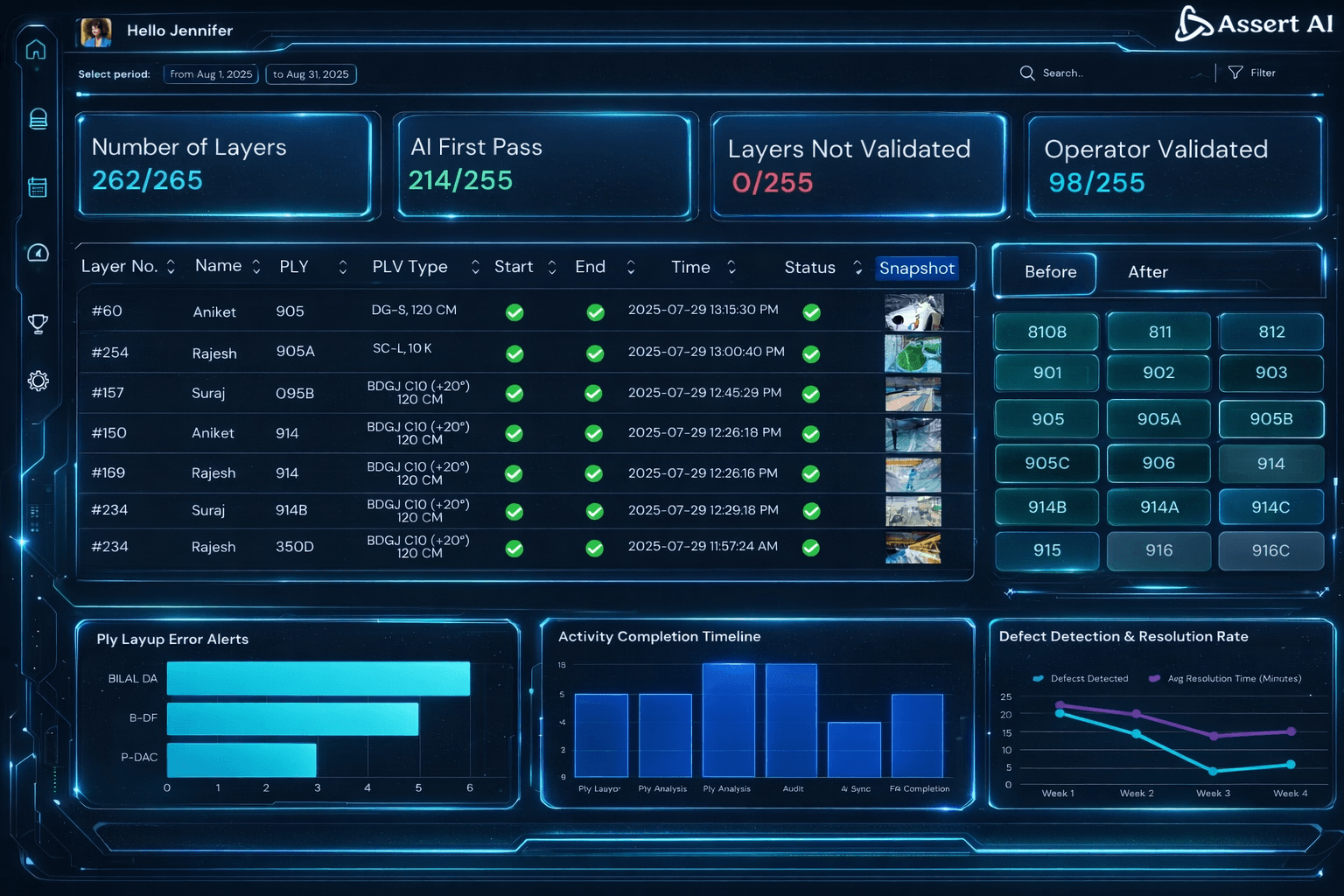
Vision systems observe the layup process directly by tracking ply edges, orientation, sequence, and coverage without interrupting operators.
Step 2: Model-driven deviation identification
AI models compare live execution against the digital layup definition, identifying misalignment, missed plies, overlaps, or sequence errors as they occur.
Step 3: Operator feedback and corrective loops
Instead of logging defects after completion, operators receive immediate, contextual guidance; allowing correction before downstream impact.
Step 4: Continuous learning from outcomes
Over time, the system correlates execution patterns with FPY, rework, and audit findings- strengthening AI in quality management, not just inspection.
Platforms like Orbit, for example, are used in wind blade manufacturing to verify each ply during layup, ensuring that even builds involving 500+ plies remain controlled, traceable, and deviation-free.
Where does AI for quality assurance create real value in composite manufacturing plants?
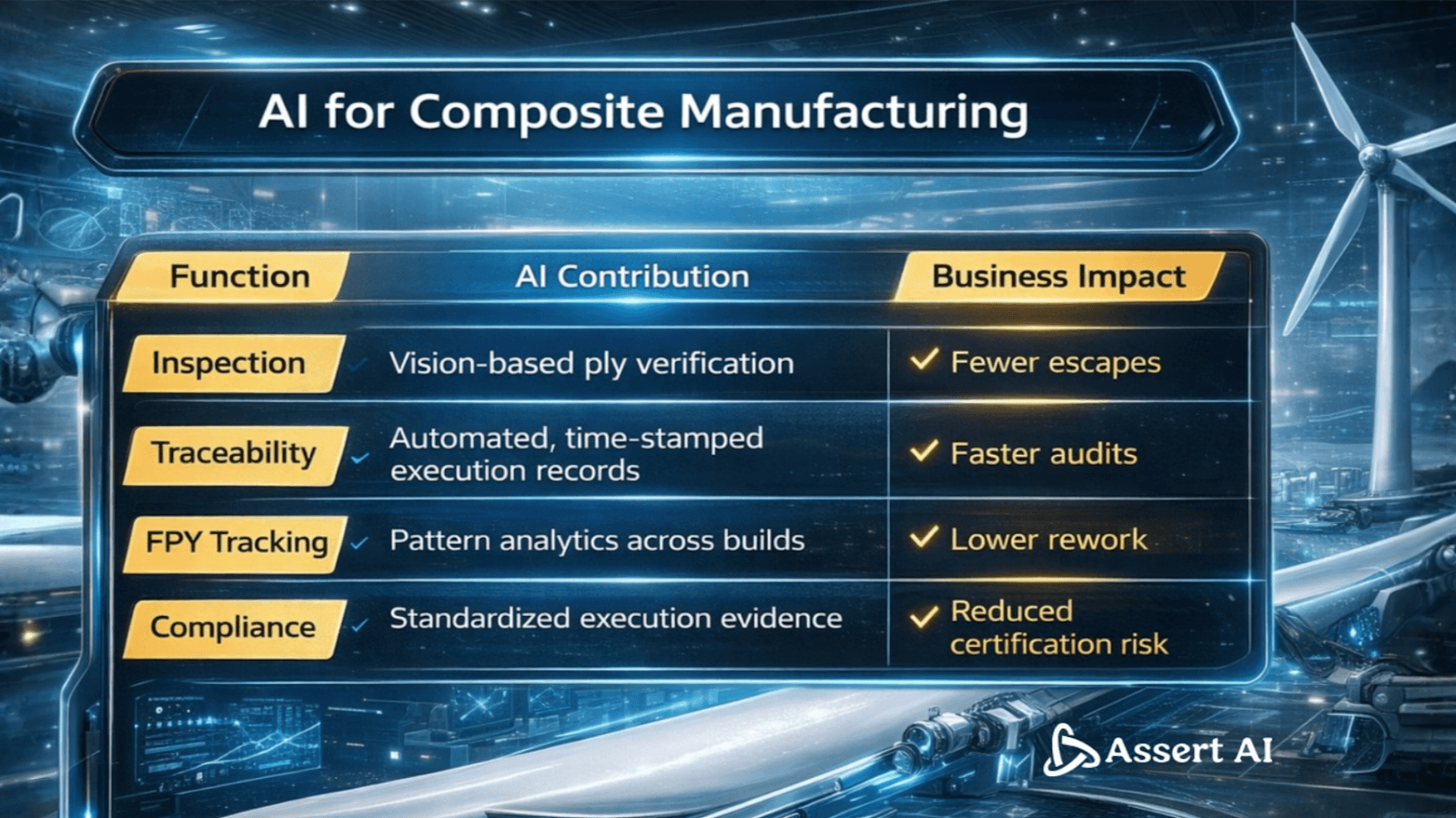
For AI for quality assurance, the real win is not automation but confidence. Confidence that what was designed is exactly what was built.
What measurable results can manufacturers expect from AI-driven quality control?
When applied to execution-critical stages like layup and infusion, wind blade manufacturers typically see:
- Reduction in rework and scrap through early deviation containment
- Improved First Pass Yield by preventing compounding errors
- More consistent inspection outcomes across shifts and sites
- Standardized quality evidence ready for internal and external audits
Used correctly, AI for manufacturing quality control becomes a lever for predictability and not just defect detection.
How is AI in quality control different from quality management and quality assurance?
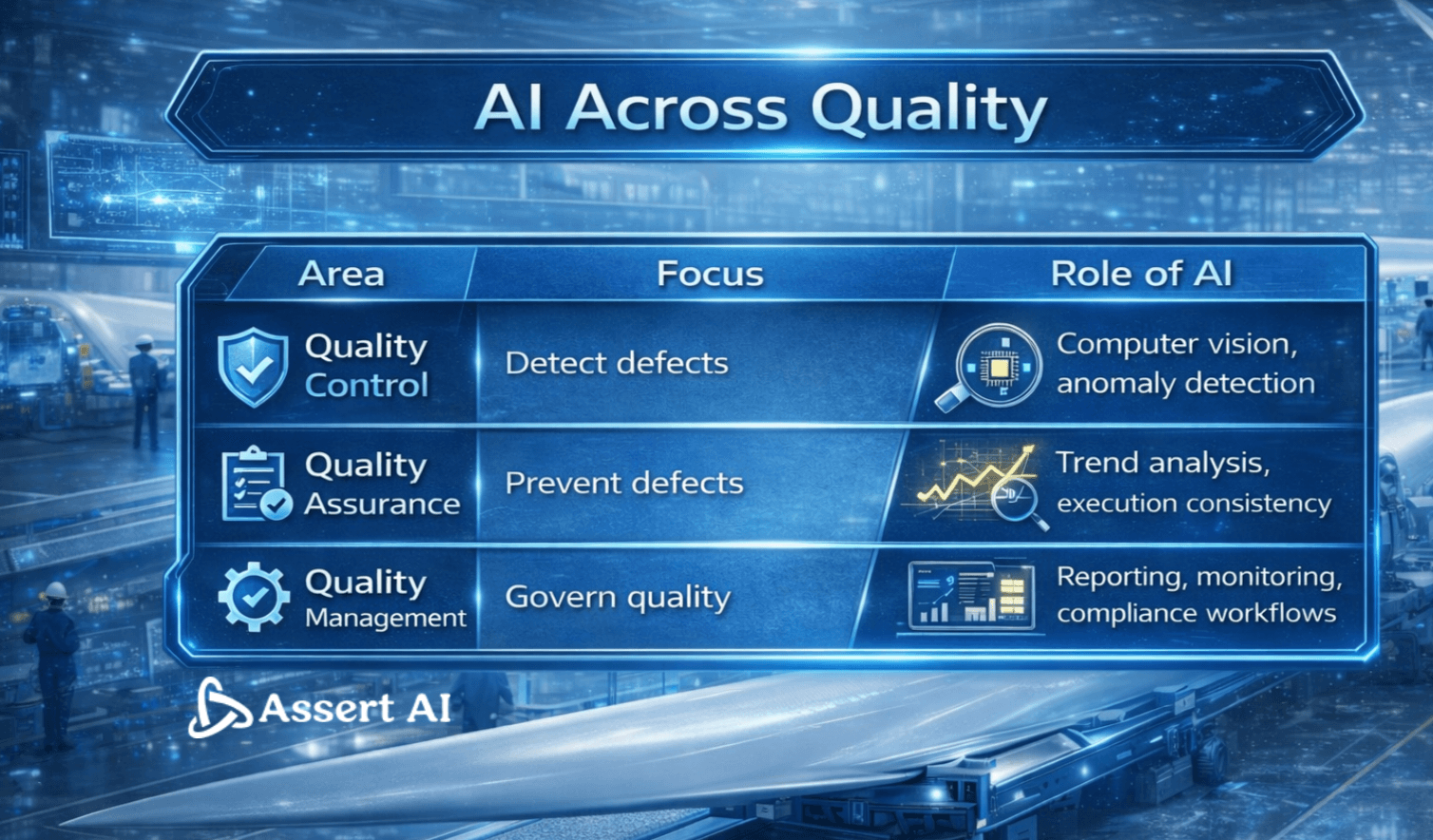
In composite environments, these layers often blur. AI helps separate detection, prevention, and governance- while connecting them through shared execution data.
This is where AI in quality management evolves from dashboards into operational intelligence.
What challenges should composite manufacturers prepare for when adopting AI for quality?
AI adoption is not friction-free, and pretending otherwise erodes trust. Common realities include:
- Data readiness
Clean definitions of what “correct execution” actually means are essential.
- Integration with MES and QMS
AI must complement existing systems, not create parallel workflows.
- Workforce adoption
Operators need AI to feel assistive, not supervisory.
- Governance and change management
Clear ownership of decisions when AI flags deviations is critical.
Addressing these early is what separates pilots from production systems.
How should organizations roll out AI-based quality control without disrupting operations?
- Define execution baselines for defects, rework, and FPY
- Start with one process stage typically layup or inspection
- Train models on real, observed deviations, not ideal scenarios
- Measure early outcomes against existing KPIs
- Scale gradually across molds, lines, or plants
This phased approach keeps AI grounded in reality where composite manufacturing actually happens.
Where does Orbit fit into the quality transformation journey?
We work with composite manufacturers who operate at the edge of scale, regulation, and engineering complexity. Our role is not to sell tools but to help teams make execution visible, verifiable, and repeatable.
Through Orbit, we’ve partnered with manufacturers to bring AI directly onto the shop floor to support operators, strengthen audits, and improve FPY without disrupting production rhythm.
The focus is always the same: control without friction, evidence without overhead.
What’s the real takeaway for composite manufacturers considering AI for quality control?
AI is not a shortcut to quality.
It’s a way to lock quality into execution, rather than chasing it after defects appear.
For composite manufacturers, the opportunity lies in using AI to reduce variability, strengthen confidence, and build digital proof into every critical step. When adopted thoughtfully, AI becomes less about technology and more about control, clarity, and trust.
If you’re exploring this path, start with the process that matters most and make it visible first.
FAQs
How does AI-based quality control differ from traditional visual inspection?
AI delivers consistent, fatigue-free verification and learns execution patterns over time, rather than relying solely on individual judgment.
Can AI for manufacturing quality control work with existing machines and inspection systems?
Yes. Most implementations integrate alongside existing tech stack and follow a phased rollout to minimize disruption.
Does AI help with both quality control and quality assurance?
Yes. AI for quality assurance focuses on prevention and consistency, while AI for quality control addresses real-time detection.
What type of data is needed for AI-driven inspection to be effective?
AI-driven inspection relies primarily on visual data captured directly from the shop floor, along with examples of correct execution, defects, and deviations. Beyond training models to recognise issues, this data enables the AI system to understand how each process step should be performed. By continuously verifying that the right sequence, method, and parameters are followed, the system helps enforce standard procedures in real time reducing the likelihood of defects or deviations before they occur.
Is AI suitable only for high-volume composite manufacturing?
No. AI is just as valuable in low-volume, high-complexity builds where even a single deviation can carry high financial, safety, or certification risk.
How long does it usually take to see measurable quality improvements?
Most manufacturers observe FPY and rework improvements within the first few months of a focused pilot.
How does Assert AI support manufacturers during implementation?
Assert AI steps in with a partnership-led approach to help teams define execution baselines, deploy gradually, and scale with confidence.