
In composite manufacturing, the impact of manufacturing quality related issues is usually measured in scrap, rework, or material waste. But the real financial damage begins long before a part is rejected. When defects disrupt flow, delay curing, or force rework cycles, they quietly reduce usable output without ever appearing on a scrap report.
Across modern composite manufacturing processes like wind blade layup and resin infusion, the real loss is not material. It is capacity. And for performance focused manufacturers, the challenge is no longer just defect detection. It is understanding how quality variability erodes throughput, cycle efficiency, and ultimately, margin.
What Does “Lost Yield” Actually Mean in Composite Manufacturing?
Lost yield in composite manufacturing refers to the gap between theoretical production capacity and actual accepted output. Unlike scrap, which is visible and accounted for, lost yield accumulates silently through delays, rework cycles, and extended processing time.
In wind blade manufacturing, for example, a small misalignment during ply layup may not result in rejection. But it can trigger additional inspection, localized repair, and delayed infusion scheduling. The blade is acce in pted, but the line loses hours of productive time.
Lost yield includes:
- Reduced first pass acceptance rates
- Capacity dilution due to rework and repair cycles
- Throughput delays across curing, trimming, or finishing stages
- Margin compression per accepted unit
Across complex composite manufacturing processes, these micro disruptions add up to significant annual output loss.
What Does Yield Loss Do to Annual Revenue Projections?
Consider a simplified example from a wind blade facility:
- 5% overall defect occurrence
- 2% results in scrap
- 3% requires rework or delayed processing
- Net effect: 1.5% reduction in effective annual yield
Source: https://www.sciencedirect.com/science/article/pii/S0960148123011710#:~:text=Highlights,and%20blade%20element%20momentum%20theory.
That 1.5% may appear small. But at scale, it translates into:
- Lower realized output against installed capacity
- Increased cost per accepted blade
- Reduced contribution margin due to fixed cost absorption
For large composite operations, manufacturing yield optimization is not just a quality initiative. It is a revenue protection strategy. Even modest improvements in lost yield in composite manufacturing can unlock significant additional production without adding new molds, labor, or floor space.
Why Is Scrap Only a Fraction of the Cost of Composite Defects?
Most manufacturers associate the cost of composite defects with material waste. In reality, the visible cost layer is only a small portion of the economic impact.
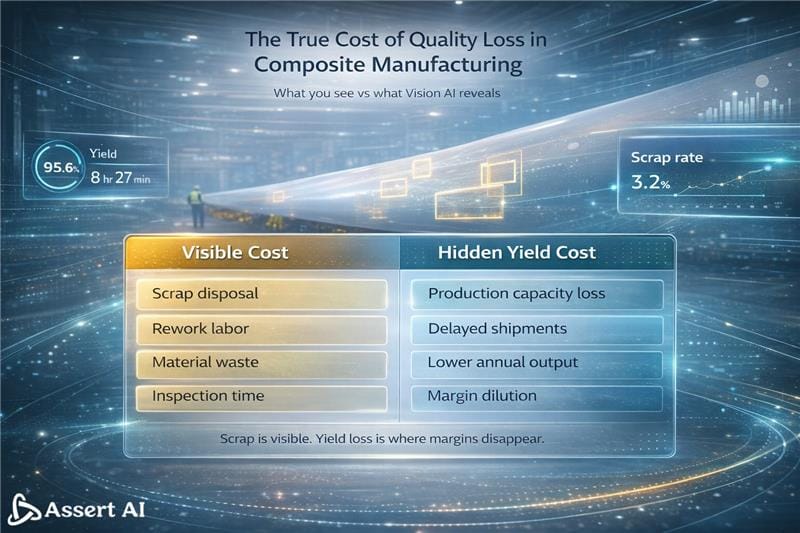
The true cost of composite defects lies in opportunity loss. A blade that requires repair instead of rejection still occupies mold time, labor, and curing capacity. Over a year, even minor composite manufacturing defects can reduce effective plant throughput by several percentage points.
How Do Composite Material Defects Reduce Effective Production Capacity?
A. Defect Propagation Across Stages
In wind blade manufacturing, early stage issues often cascade downstream. A fiber misalignment or air pocket introduced during ply layup may only become visible during infusion or ultrasonic inspection. By that point, the blade has already consumed significant mold time.
Similarly, incomplete wet-out during resin infusion can trigger localized dry spots, requiring additional vacuum cycles or repair before curing. Each correction extends cycle time and disrupts production planning.
B. Compounded Delay Effect
- Inspection queues increase when defects cluster in a batch
- Rework cycles reduce available mold and labor hours
- Infusion or curing rescheduling creates bottlenecks across the line
These small disruptions caused by composite material defects accumulate into measurable capacity loss across composite manufacturing processes.
Where Do Traditional Manufacturing Quality Systems Fall Short?
Most manufacturing quality related systems are built around detection and compliance rather than capacity protection. They focus on identifying defects after formation instead of preventing their operational impact.
Common limitations include:
- Reactive detection after the process stage is completed
- Manual review delays during visual inspection
- Data fragmentation across layup, infusion, and curing stages
- Limited ability to predict recurring defect patterns
In composite environments, this reactive approach allows composite manufacturing defects to influence throughput long before they appear in reports.
How Does Assert AI Redefine Manufacturing Yield Visibility?
Assert AI approaches manufacturing quality related performance as a yield intelligence problem rather than an inspection task. Instead of focusing only on pass or fail outcomes, the system provides visibility into early process deviations that influence throughput.
In wind blade production, this enables operators to identify anomalies during ply placement or infusion process before they propagate into downstream defects.
Key capabilities include:
- Real time detection of early stage deviations linked to composite material defects
- Identification of layup inconsistencies, bridging, or resin infusion risk zones
- Yield impact analytics that connect quality events to cycle time and capacity loss
The result is operational clarity. Not just what failed, but what is quietly reducing output.
What Does Proactive Yield Optimization Look Like in Practice?
A future ready composite operation follows a structured approach:
- Continuous defect mapping across ply layup and infusion stages
- Yield impact tracking linked to cycle time and resource utilization
- Predictive modeling of recurring defect patterns by material batch, team, or process condition
- Process recalibration to stabilize flow across composite manufacturing processes
This operational model shifts the focus from inspection volume to manufacturing yield optimization.
The real challenge in composite manufacturing is not measuring scrap. It is managing the operational impact of manufacturing quality related variability. Scrap is visible and accounted for. Lost capacity, delayed cycles, and diluted throughput are not.
When manufacturers evaluate the cost of composite defects, the strategic question is no longer how much material was wasted. It is how much production potential was quietly lost. The next generation of quality strategy will focus less on rejection rates and more on protecting yield, stability, and output.
FAQs
How are composite manufacturing defects different from normal material waste?
Composite manufacturing defects include issues like voids, wrinkles, or dry spots that disrupt flow and performance. Unlike routine material loss, these composite material defects reduce throughput and usable capacity.
Why is lost yield in composite manufacturing more expensive than scrap?
Scrap creates a one time material loss. Lost yield in composite manufacturing reduces production capacity and increases unit cost, making the long term cost of composite defects significantly higher.
What role do composite manufacturing processes play in defect formation?
Variability during layup, vacuum setup, curing, or inspection stages accumulates over time. Small deviations across composite manufacturing processes can compound into significant yield instability.
How does manufacturing yield optimization reduce long term defect costs?
Manufacturing yield optimization focuses on early stage detection and process stabilization. Preventing deviations reduces rework cycles, protects capacity, and improves margin consistency.
Are manufacturing quality related metrics enough to prevent yield loss?
Traditional manufacturing quality related metrics measure defect counts. Preventing yield erosion requires visibility into how quality events affect cycle time, capacity, and operational flow.