Wind blade manufacturing has always carried a difficult quality challenge. The product is large, the process is layered, the materials are sensitive, and many critical defects are created long before final inspection begins. By the time a blade reaches curing, finishing, or end of line checks, quality is often already locked into the structure.
That is why APQP4Wind compliance matters so much for blade manufacturers. It pushes quality teams to move upstream, plan better, control process risks earlier, validate execution more consistently, and prove that the right process was followed before defects become expensive failures.
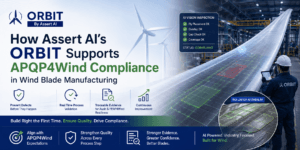
For manufacturers searching for manufacturing quality inspection software that does more than detect defects at the end of production, Assert AI’s ORBIT brings a practical answer. ORBIT is designed to help wind blade manufacturing teams build right the first time by embedding AI vision for wind blade inspection, real time process control, traceability, and operator guidance directly into production.
It supports the core intent of APQP4Wind compliance, not as another paperwork layer, but as a smarter way to make quality visible, measurable, and defects preventable during manufacturing.
What APQP4Wind Expects From Wind Blade Manufacturers
APQP4Wind compliance adapts the principles of Advanced Product Quality Planning for the wind industry. In simple terms, it expects manufacturers and suppliers to plan quality before production, identify risks early, define how critical process steps will be controlled, validate product and process readiness, and maintain evidence that requirements have been met.
For wind blade manufacturing, this becomes especially important because a blade is not a simple assembled product. It is a high value composite structure built through multiple sensitive stages, including material handling, ply placement, layup sequence control, bonding, infusion, curing, trimming, finishing, and inspection.
APQP4Wind compliance expects manufacturers to build quality into this journey through:
Clear product and process requirements
Risk based planning across critical production steps
Defined controls for special and critical characteristics
Process flow discipline and documented execution
Inspection and validation methods that support customer requirements
Measurement and capability evidence where relevant
Traceable records for review, approval, and continuous improvement
PPAP4Wind readiness that proves the process can repeatedly deliver conforming output
In practical terms, APQP4Wind compliance asks a blade manufacturer a very direct question:
Can you prove that the blade was built correctly, not just inspected later?
This is where traditional inspection models begin to struggle.
Why Traditional Wind Blade Inspection Falls Short
Many blade manufacturers still depend heavily on manual checks, delayed quality review, photographs, paper based logs, or post process inspection. These methods are useful, but they are limited.
They usually detect issues after the process has moved forward. They depend on operator judgment. They may miss subtle placement deviations. They may not capture every step with enough objectivity. They may not provide a complete validation record that connects the actual build process to the required specification.
In wind blade manufacturing, this creates a costly gap.
A ply placed incorrectly, a sequence missed, a material overlap issue, a wrinkle, a foreign object, or an infusion anomaly may appear small at the moment it happens. But once the blade moves ahead, the cost of correction rises quickly. After infusion or curing, some defects become difficult to rework, expensive to investigate, or impossible to correct without significant production loss.
APQP4Wind compliance encourages the opposite mindset. It asks manufacturers to focus on defect prevention in manufacturing, not simply catch defects later. That requires manufacturing quality inspection software that works during production, not only after production.
How ORBIT Supports APQP4Wind Compliance
ORBIT: Optimized Real Time Blade Inspection and Tracking is designed around a simple but powerful idea: quality must be built into every step of wind blade manufacturing.
ORBIT uses AI vision for wind blade inspection to validate critical production activities as they happen. Instead of waiting for downstream inspection, it helps manufacturers confirm that each important step is being executed correctly in real time.
For APQP4Wind compliance, this matters because ORBIT strengthens four major quality pillars:
Prevention
Process control
Traceability
Continuous improvement
By converting shop floor activity into structured, visual, time stamped quality intelligence, ORBIT helps manufacturers create stronger evidence for audits, customer reviews, process validation, and internal quality performance improvement.
From Defect Detection to Defect Prevention
Most manufacturing quality inspection software is built around detection. It identifies a defect, flags a deviation, and alerts the team. That is valuable, but for wind blade manufacturing, detection alone is not enough.
ORBIT is designed to move quality further upstream.
During blade production, ORBIT can help validate whether the correct ply is placed in the right location, in the right sequence, and according to defined process expectations. It can support real time process control during layup and monitor critical production zones where manual variability is high.
This helps manufacturers strengthen defect prevention in manufacturing before issues become embedded into the blade structure.
That is closely aligned with APQP4Wind compliance and its preventive quality approach. Instead of relying only on final inspection, manufacturers can create a closed loop between instruction, execution, and verification.
The result is a stronger build right the first time.
Real Time Process Validation for Wind Blade Manufacturing
Turbine blade manufacturing process involves hundreds of steps where accuracy matters. Even a small deviation can affect quality, rework, cycle time, and customer confidence.
ORBIT supports in process quality validation by bringing AI vision for wind blade inspection into the production flow. Cameras and edge based processing can observe defined production zones and compare actual execution against expected process requirements. This enables the system to flag deviations quickly, when operators can still correct them.
For example, in composite layup, ORBIT can help teams verify whether placement is aligned with the required build sequence. In infusion related workflows, it can support better process visibility and reduce dependence on subjective decisions. In both cases, the goal is not to replace the quality team, but to give them objective, timely, and actionable process intelligence.
This is where quality inspection software for manufacturing becomes more than an inspection tool. It becomes a production control layer.
Stronger Traceability for APQP4Wind and PPAP4Wind Readiness
APQP4Wind compliance is not only about doing the right things. It is also about proving that the right things were done.
This is a major challenge in wind blade manufacturing because manual records often fail to capture the full production reality. A checklist may confirm that a step was completed, but it may not show how it was completed. A photograph may capture a moment, but not the entire process context. A human observation may be valid, but difficult to standardize across shifts, sites, and production lines.
ORBIT helps close that gap by generating a digital trail of process validation.
This can include step level records, visual evidence, timestamps, deviation alerts, corrective actions, and execution history. For APQP4Wind compliance and PPAP4Wind readiness, this kind of traceability can strengthen confidence because it links process intent with actual shop floor execution.
For quality leaders, this changes the conversation from:
“We inspected the blade.”
to:
“We can show how the blade was built, where each critical step was validated, and when deviations were corrected.”
That is a far stronger position for compliance, customer assurance, and internal quality governance.
Supporting Risk Based Quality Planning
APQP4Wind compliance places strong emphasis on risk based planning. Wind blade manufacturing teams must identify where failure can occur, where variation is likely, and where controls are needed most.
ORBIT supports this approach by helping manufacturers focus on high risk production points where manual variability, process complexity, or delayed detection can create expensive quality issues.
In wind blade manufacturing, these risk points often include:
✪ Ply placement accuracy
✪ Layup sequence adherence
✪ Material orientation and positioning
✪ Process step completion
✪ Foreign object presence
✪ Deviation correction before the next step
✪ Infusion visibility and process consistency
✪ Operator dependent judgment points
By applying AI vision for wind blade inspection to these areas, ORBIT helps manufacturers move from assumption based control to evidence based control.
Over time, the data generated by ORBIT can also help quality teams identify recurring deviations, process bottlenecks, training gaps, and opportunities for standardization. This supports the continuous improvement mindset that APQP4Wind compliance expects across the value chain.
Building Right the First Time With ORBIT
The phrase build right the first time is easy to say, but hard to execute in a complex blade factory.
The production staff must be well aware of what should occur next. The quality team must confirm execution without slowing down the process. Supervisors must recognize deviations early. Plant leadership must be aware of the areas where quality risks are emerging. Customers must have faith that the production process is under control.
ORBIT helps by turning production visibility into production control.
It can notify teams when action is required rather than waiting for manual evaluation. It can produce organized traceability in place of dispersed records
This is how manufacturing quality inspection software can support first pass quality in wind blade manufacturing. It gives the factory a practical way to reduce rework, improve consistency, support APQP4Wind compliance, and build confidence into every blade.
How ORBIT Aligns With APQP4Wind Expectations
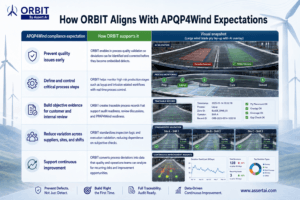
Assert AI’s ORBIT significantly bolsters APQP4Wind compliance by transitioning quality management from reactive detection to proactive prevention. By enabling in-process quality validation, ORBIT ensures that deviations are identified and corrected before they become embedded defects, while simultaneously providing real-time process control for high-risk production stages like layup and infusion. Furthermore, the platform creates objective, traceable records that support audit readiness and PPAP4Wind requirements, all while standardizing inspection logic to reduce subjective variability across shifts and sites. Ultimately, ORBIT transforms process deviations into actionable data, empowering quality and operations teams to identify recurring risks and drive continuous improvement throughout the wind blade manufacturing lifecycle.
For quality teams, this means fewer blind spots.
For operators, it means clearer guidance.
For plant heads, it means better process control.
For customers, it means stronger confidence in manufacturing discipline.
APQP4Wind Needs Proof, ORBIT Helps Create It
APQP4Wind compliance doesn’t expect the right forms, templates, and quality language alone. The idea is to also be able to prove that quality has been planned, controlled, validated, and improved across the manufacturing process.
For wind blade manufacturing teams, this proof must come from the shop floor.
Assert AI’s ORBIT helps make that possible. By embedding AI vision for wind blade inspection into wind blade manufacturing, ORBIT helps manufacturers prevent defects, validate execution, strengthen traceability, and build right the first time.
In an industry where blade quality directly affects cost, reliability, delivery timelines, and customer trust, ORBIT turns quality from a final checkpoint into a real time manufacturing advantage.
Want to see how this works on the factory floor?
View the wind blade quality inspection success story and discover how ORBIT helped move blade production from late inspection to real time process control.