Warehouses do not have the luxury of pausing operations for transformation.
Orders keep moving. Trucks keep arriving. Labor windows stay tight. Customer SLAs do not soften because a new technology is being installed. For senior logistics and warehouse leaders, this is the real tension around AI for warehousing. The promise is attractive, but the fear is practical. Will deployment slow the floor down? Will dock activity get interrupted? Will teams have to change too much too quickly? Will the system create more noise than value?
The answer depends on how AI is deployed.
A well planned AI implementation does not require a warehouse to stop, reset, and restart. It works around the rhythm of the operation. It observes before it intervenes. It supports warehouse management instead of creating another disconnected dashboard. Most importantly, it starts with a problem worth solving, not with a vague desire to “bring in AI.”
For warehouses, distribution centers, 3PLs, fulfillment hubs, cold storage facilities, and manufacturing logistics teams, the smartest AI deployments are not the loudest ones. They are the ones that improve accuracy, safety, throughput, and visibility while the operation continues to run.
Start With a Quantified Problem, Not With the Idea That “We Need AI”
The wrong way to start an AI initiative is with the statement:
“We need AI in the warehouse.”
That is not a business objective. It is a technology preference.
Experienced warehouse leaders do not invest in technology because it is innovative. They invest because a process is underperforming against a measurable target.
The conversation should sound more like this:
- Dock reconciliation is consuming two labor hours per shift.
- Inventory variance is exceeding tolerance levels.
- Loading errors are driving customer claims and rework.
- Trailer dwell time is increasing during peak periods.
- Forklift and pedestrian interactions remain a recurring safety concern.
These are operational constraints. They have a measurable impact on cost, throughput, service levels, compliance, and safety. More importantly, they have clear business owners accountable for improving them.
That is where AI becomes relevant.
Before evaluating any AI solution, warehouse leaders should define the specific operational metric they want to improve and establish a baseline.
Research from Auburn University’s RFID Lab has consistently shown that many retailers achieve only 60–70% inventory accuracy, despite operating modern warehouse and inventory systems. So if inventory accuracy is the concern, the organization should know its current variance rate, audit effort, stock adjustment costs, and target improvement.
If dispatch accuracy is the issue, it should understand the frequency and financial impact of loading errors, shipment discrepancies, and customer claims. If safety is the priority, the baseline should include incident rates, near misses, restricted-zone violations, PPE non-compliance, and forklift-pedestrian interactions.
Without a baseline, it becomes difficult to determine whether AI improved performance or simply introduced another layer of monitoring.
A strong problem statement might look like this:
“The facility experiences an average of 18 loading discrepancies per month, resulting in claims, rework, and delayed dispatches. The objective is to reduce loading errors by 60 percent within six months through automated visual verification.”
Or:
“The site recorded 11 forklift-pedestrian proximity incidents last quarter. The objective is to identify unsafe movement patterns and reduce repeat occurrences through continuous visual monitoring.”
The reality is that most organizations already possess the data required to build these business cases.
WMS, ERP, TMS, quality management systems, customer complaint records, and operational dashboards routinely capture indicators such as inventory adjustments, shipment errors, dwell times, claims, productivity losses, and rework costs. The challenge is rarely a lack of data. It is connecting the data to a clearly defined operational problem.
Even where digital visibility is limited, evidence usually exists elsewhere. Incident investigations, audit findings, shift reports, CAPA records, manual checklists, customer escalations, and weekly operational reviews often reveal recurring issues long before they appear on a dashboard.
The same applies to safety. Near misses, incidents, unsafe behaviors, equipment interactions, and compliance violations are typically documented through EHS systems, insurance records, internal investigations, and regulatory reporting requirements. Whether reported under Occupational Safety and Health Act (OSHA) in the United States, Health Act (OSHA)Factories Act, 1948 in India or other occupational safety regulations in other regions, these records provide the baseline needed to measure risk reduction.
The strongest AI initiatives do not begin with a search for use cases. They begin with a known operational constraint that is already affecting cost, service, productivity, accuracy, or safety. In most warehouses, that constraint has already been measured somewhere. Leaders simply need to uncover it.
For a deeper view of how AI supports warehouse visibility beyond conventional systems, read Assert AI’s blog on AI in warehouse management beyond WMS.
Why AI Deployment Often Disrupts Warehouse Operations
Downtime usually does not happen because AI is complex. It happens if implementation is poorly planned.
Warehouses run into trouble when deployment begins with large infrastructure changes, unclear success metrics, heavy hardware replacement, disconnected software workflows, or a sudden change in how operators are expected to work.
The most common mistakes include replacing functioning camera networks without first checking whether they can support the use case, rolling out too many AI modules at once, installing systems before validating floor realities, and expecting warehouse teams to trust alerts before the system has been tested in live conditions.
Senior operations leaders know that the warehouse floor is not a lab. Lighting changes. Pallets block views. Forklifts reroute. Seasonal volume changes the flow. Temporary labor may not follow the same movement patterns as experienced workers. Any AI deployment that ignores this reality will struggle.
The better approach is to deploy AI in a way that respects live operations. This means beginning with use case clarity, assessing camera visibility, running the system in observation mode, validating outputs, integrating with warehouse management workflows, and scaling once measurable value is proven.
Why the Right Use Case Matters More Than the Size of the Deployment
The fastest path to value is not a warehouse wide AI rollout. It is one clearly defined, high impact use case.
Physical AI for warehousing can support many areas, including inventory tracking, dock management, dispatch verification, vehicle movement monitoring, put away accuracy, safety compliance, cycle counting, asset utilization, and throughput improvement. But trying to solve everything at once can dilute focus and delay adoption.
A better strategy is to choose a use case where three conditions are present.
First, the problem is frequent enough to matter. Second, the cost of the problem is visible. Third, the process can be observed through cameras or video feeds with sufficient clarity.
For example, if loading errors are creating customer claims, you should verify the right goods, vehicle, dock, and dispatch sequence before shipments leave your facility using Vision AI. If dock congestion is impacting turnaround times, you need to pinpoint bottlenecks and dwell patterns to keep operations moving efficiently. If safety incidents are recurring in specific movement zones, you should identify risky interactions early and take timely corrective action before they escalate.
The use case should be valuable enough to win executive attention and narrow enough to deploy without disturbing the entire facility.
Assert AI’s warehouse automation solutions and real time warehouse tracking blog offer useful examples of how computer vision can support warehouse efficiency and operational visibility.
General Purpose Security Cameras Are Often Better Than Specialized AI Cameras
One of the most expensive misconceptions in warehouse AI implementation is that every use case requires specialized AI cameras.
In many cases, it does not.
General Purpose Camera Strategy is an implementation model that prioritizes standard security cameras over dedicated AI cameras, allowing multiple Vision AI applications to share the same video infrastructure. For most warehouse management applications, general purpose security cameras are a smarter, more scalable choice. They are easier to procure and maintain while supporting multiple use cases over time.
Specialized AI cameras are often designed for a single purpose. While effective for isolated tasks, warehouses need visibility across multiple workflows. A single camera overlooking a dock door can verify shipments, monitor loading activity, measure turnaround times, track equipment movement, and identify safety risks simultaneously. A general-purpose Vision AI platform unlocks multiple use cases from the same camera investment without locking organizations into specific hardware or vendor ecosystems.
General purpose security cameras also give warehouse leaders greater flexibility. Depending on camera placement and video quality, they can support object detection, movement tracking, safety monitoring, vehicle tracking, pallet counting, loading verification, and operational analytics.
This flexibility matters because warehouse operations constantly evolve. SKU profiles, layouts, customer requirements, and seasonal demand all change. A strategy built on general purpose security cameras adapts with the operation instead of limiting future use cases.
It also improves deployment economics. Rather than replacing entire camera networks, organizations can first evaluate whether existing CCTV cameras provide the visibility required for the business problem. Where coverage is insufficient, additional general purpose security cameras can be installed without the cost of a complete hardware overhaul.
Existing Cameras Can Work, But Only If They Fit the Problem Statement
It is tempting to say AI can run on any camera. That may not be the right way to frame it.
A more accurate statement is this: existing general purpose security cameras can often be used if their positioning, field of view, resolution, lighting, and coverage match the problem statement.
If the use case is truck entry and exit logging, the camera must clearly capture the vehicle, license plate area, movement direction, and gate activity. If the use case is dock safety, the camera must capture pedestrian and forklift interaction zones. If the use case is dispatch verification, the camera must see the relevant loading area clearly enough to identify activity and sequence.
One mistake we repeatedly see is when existing camera positions are not aligned with the use case, people seek answers in specialized AI cameras. In most cases, any suitable general purpose security camera can be installed in the right position. Most modern general purpose security cameras, especially IP cameras with sufficient resolution and video quality, are compatible with AI vision solutions.
The key is not whether the camera is branded as an AI camera. The key is whether the video feed gives the AI system the visual evidence it needs.
This approach gives warehouse leaders a practical path forward. Use what works. Add what is needed. Avoid unnecessary replacement.
Conduct a Camera Readiness Assessment Before Deployment
Before finalizing any AI deployment plan, we conduct a camera readiness assessment to evaluate whether the existing camera infrastructure can support the intended operational outcomes and deliver the required level of accuracy.
This assessment should answer practical questions.
Can the target process be seen clearly?
Are there blind spots during peak activity?
Does lighting change across shifts?
Are objects frequently blocked by people, forklifts, racks, doors, or stacked pallets?
Is the camera angle useful for detection, counting, tracking, or verification?
Does the video quality support the level of accuracy the use case requires?
Can the camera feed be accessed securely and reliably?
This step prevents one of the most common implementation failures: deploying AI on video feeds that were never positioned for the intended business problem.
For example, a camera originally installed for general security may provide a broad view of an area, but not the detail needed for pallet level verification. Another camera may capture a dock door but miss the staging zone where the actual loading sequence begins. A third camera may work well during the day but fail in low light conditions during night operations.
The goal is not to flood the warehouse with more cameras. The goal is to make sure the camera view matches the workflow that needs intelligence.
Run AI in Observation Mode Before Changing the Process
The safest way to deploy AI without operational downtime is to let the system observe first.
In observation mode, AI runs in parallel with existing processes. It watches the operation, captures events, generates insights, and compares outputs against current records without forcing immediate workflow changes.
This phase is valuable for several reasons.
It helps validate model accuracy in real operating conditions. It gives operations teams time to understand what the system is detecting. It allows managers to compare AI insights with WMS data, manual logs, safety reports, and supervisor observations. It also builds trust before AI generated alerts become part of daily decision making.
For warehouse teams, trust is not built through a presentation. It is built when the system correctly identifies a recurring dock delay, captures a missed safety behavior, flags a loading mismatch, or reveals movement patterns that supervisors already suspected but could not quantify.
Observation mode also reduces resistance. Operators do not feel that the system is suddenly changing their work. Managers get evidence before enforcement. Leadership gets a measured view of value before scaling.
That is how AI becomes useful instead of intrusive.
Integrate AI With Warehouse Management, Do Not Add Another Island
AI should not become another screen that supervisors have to check between the WMS, yard system, labor dashboard, ERP, email, radio calls, and spreadsheets.
For AI for warehouse management to work, it must fit into existing decision flows.
If the AI system detects a loading exception, the right team should receive the alert where action can actually happen. If it identifies excessive dwell time, the insight should connect to dock planning or yard coordination. If it tracks inventory movement, the data should support warehouse management processes rather than sit in a separate analytics portal.
Strong integration can include WMS connections, ERP connections, API based alerts, dashboard reporting, automated documentation, exception workflows, and historical analytics.
The purpose is simple: AI should make warehouse management sharper, not heavier.
This is especially important for senior logistics leaders managing multi site operations. A solution that works beautifully in one facility but cannot integrate into enterprise systems will struggle to scale. A solution that connects with existing warehouse management workflows can become a repeatable operating layer across locations.
For dock and yard related use cases, Assert AI’s LOGIX productivity tool shows how AI can support gate logs, dwell time visibility, and dock scheduling.
Use Edge AI Where Real Time Decisions Matter
Many warehouse events lose value if the insight arrives late.
A forklift proximity alert, a wrong loading sequence, a dock congestion event, an unauthorized movement, or a safety breach needs timely detection. This is where edge AI becomes important.
Edge AI processes video closer to the source instead of depending entirely on cloud based processing. For warehouse environments, this can reduce latency, lower bandwidth dependency, improve reliability, and support faster response.
This is especially useful in large facilities, high traffic dock areas, cold storage environments, remote yards, and operations where network conditions may not always be ideal.
For senior warehouse leaders, the point is not the technical architecture alone. The point is operational continuity. AI should keep working when the floor is busy, when the network is strained, and when decisions need to be made quickly.
Assert AI’s productivity and throughput improvement solutions highlight how real time monitoring and AI driven insights can support operational efficiency.
Start With a Pilot That Has Real Business Stakes
A pilot should not be a science project in a quiet corner of the warehouse.
It should focus on a real process with measurable impact.
Good pilot areas include loading docks, receiving zones, high value inventory areas, dispatch lanes, gate operations, pedestrian forklift interaction zones, and staging areas where errors or delays are already visible.
The pilot should have a defined baseline, a target outcome, a timeline, and a clear decision path. Before starting, leaders should know what success looks like.
For example:
Reduce loading discrepancies by 40%.
Cut manual gate logging time by 70%.
Improve dock turnaround visibility across all peak windows.
Reduce repeated PPE non compliance in a defined zone.
Improve inventory reconciliation speed in a high variance area.
The pilot should also include operational feedback. Supervisors, safety managers, dispatch leads, forklift operators, warehouse associates, and IT teams all see different parts of the reality. Their input can make the system sharper and the rollout smoother.
Once the pilot proves value, the business can expand to adjacent use cases or additional facilities with a stronger implementation playbook.
Train Teams Without Slowing the Floor
Training does not need to stop operations. It needs to be role specific.
A warehouse associate does not need the same training as a site leader. A safety manager does not need the same dashboard view as a dispatch supervisor. A regional operations director needs performance trends, not every event clip.
The best AI deployments define who needs to know what.
Supervisors need to understand alerts, escalation logic, and how to validate exceptions. Operators need to know whether the AI system changes any immediate behavior. Safety teams need to know how incident patterns are captured and reviewed. Leadership needs to know how results will be measured.
Training should also address a practical concern: AI is not there to blame people. It is there to expose process gaps, reduce preventable errors, and help teams act earlier.
When that message is clear, adoption improves.
Measure What Changed After AI Deployment
AI value must be measured in warehouse terms.
That means fewer delays, fewer errors, better visibility, reduced manual work, improved safety compliance, stronger throughput, faster reconciliation, and better asset utilization.
Relevant metrics may include:
- Inventory accuracy improvement
- Reduction in manual audit hours
- Loading and dispatch accuracy
- Dock turnaround time
- Trailer dwell time
- Number of safety incidents and near misses
- PPE compliance rates
- Restricted zone violations
- Forklift pedestrian proximity events
- Labor productivity
- Claims and dispute reduction
- Cycle count efficiency
- Exception response time
The right metrics depend on the original problem statement. That is why the baseline matters so much.
If a warehouse does not know how many incidents were happening before AI, it cannot credibly claim that AI improved safety. If it does not know how much time was spent on manual reconciliation before AI, it cannot prove labor savings.
Industry estimates suggest that order picking and shipping errors cost warehouses between $20 and $300 per error, depending on the value of the shipment, reverse logistics, customer service effort, and retailer penalties. If you do not track dispatch errors before deployment, you cannot measure the reduction after deployment.
Strong measurement turns AI from an innovation project into an operations performance tool.
Common Mistakes to Avoid During AI Deployment in Warehouse
- Starting with technology instead of the business problem.
- Assuming specialized AI cameras are always required.
- Ignoring camera positioning and expecting AI to work from poor angles or incomplete views.
- Deploying too broadly before proving one use case.
- Treating AI as a separate system instead of integrating it with warehouse management workflows.
- Skipping observation mode and expecting teams to trust outputs immediately.
- Measuring activity instead of business impact.
Avoiding these mistakes can make the difference between a stalled pilot and a scalable AI program.
A Practical Framework for Zero Downtime AI Deployment in Warehouses
Instead of thinking about AI deployment as a technical rollout, it helps to think about it as solving one operational headache at a time.
For example, if a distribution center is struggling with recurring loading errors and every month, a handful of shipments leave with missing pallets or incorrect items, leading to customer complaints, claims, and costly investigations. Rather than deploying AI across the entire warehouse, the operations team starts by focusing only on the loading docks. They review how often these errors occur, estimate the financial impact, and identify the dock manager as the owner of the initiative.
The next step is not buying new technology immediately. The team first checks whether the existing security cameras can clearly see the loading process. In some dock lanes, the camera angles are sufficient. In others, pallets disappear behind parked forklifts or staging areas fall outside the camera view. Instead of replacing the entire camera network, they simply add a few general purpose security cameras where visibility is lacking.
Once the cameras are in place, the AI system begins observing dock activity without changing how employees work. For several weeks, supervisors compare AI-detected loading events with shipment records and manual logs. During this period, the warehouse continues operating normally, but managers start uncovering patterns they previously could not see, such as specific shifts where loading mistakes are more common or docks where congestion contributes to rushed dispatches.
A similar approach works for safety initiatives. Consider a warehouse where forklift and pedestrian interactions are a growing concern. Rather than introducing new rules immediately, AI first monitors movement patterns around high-risk intersections. The system may reveal that most near-miss situations occur during shift changes or in a particular aisle where visibility is poor. Armed with real evidence, safety managers can make targeted improvements instead of relying on assumptions.
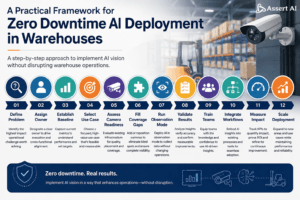
As teams gain confidence in the accuracy of the insights, alerts can be integrated into daily operations. Supervisors begin receiving notifications about loading exceptions, prolonged dwell times, or unsafe movement patterns, allowing them to intervene before problems escalate. Over time, the warehouse measures whether loading discrepancies, safety incidents, manual investigation hours, or dock delays have actually decreased compared to the original baseline.
This practical, problem-first approach allows warehouses to introduce AI gradually while keeping operations running smoothly. Rather than attempting a large-scale transformation overnight, organizations solve one measurable challenge, prove value, and then expand to additional areas with far less risk and disruption.
Frequently Asked Questions About AI for Warehousing
Can AI be deployed in a warehouse without stopping operations?
Yes. AI can be deployed without stopping operations when the project is planned around a specific use case, camera readiness is assessed in advance, and the system runs in observation mode before any process changes are introduced. The goal is to let AI learn from live operations while teams continue working as usual.
Do warehouses need specialized AI cameras?
Not always. In many cases, general purpose security cameras are a better option because they are flexible, scalable, and compatible with multiple AI use cases. Existing general purpose security cameras can often be used if their positioning, resolution, lighting, and field of view match the problem statement. Where coverage is inadequate, additional general purpose cameras can be installed.
How should a warehouse choose the first AI use case?
The first use case should be tied to a quantified operational problem. Examples include high inventory variance, recurring dispatch errors, rising dock dwell time, manual gate log delays, repeated safety incidents, or poor visibility in high movement zones. The best use case is one where the business impact is clear and the process can be captured through camera feeds.
How does AI improve warehouse management?
AI improves warehouse management by adding real time visibility to physical operations. It can help detect exceptions, verify movement, monitor safety, track assets, identify delays, and generate operational insights that traditional systems may miss. This helps warehouse leaders act on what is actually happening on the floor, not only on what has been manually entered into a system.
What should be measured before deploying AI in warehouses?
Warehouses should measure the baseline connected to the problem they want to solve. For safety, this could include incidents, near misses, PPE violations, restricted zone breaches, or forklift pedestrian proximity events. For inventory, it could include variance rates, manual audit hours, and reconciliation delays. For dispatch, it could include loading errors, claims, and shipment verification gaps.