Artificial intelligence can now watch almost anything on a manufacturing floor.
A camera can identify surface defects after a wind blade is produced. Facial recognition can automate employee attendance. Computer vision can detect intrusion into restricted areas, verify PPE compliance, flag unsafe behavior, measure idle time and generate real-time alerts. Manufacturers can also use visual analytics to study cycle times, congestion, manpower deployment and overall productivity.
All of these applications have value.
But for a wind blade manufacturer, they do not all create the same financial impact. The real question is not, “Where can we use AI?”
It is: “Where can AI prevent the largest avoidable loss?” That distinction changes the business case for manufacturing automation completely.
The easiest AI use cases are not always the highest-ROI ones
Most manufacturing facilities already have cameras. That makes general Vision AI applications relatively easy to imagine.
A manufacturer can monitor whether workers are wearing helmets and gloves. It can identify unauthorized access to sensitive areas. Facial recognition can simplify attendance management. AI can measure whether a workstation is active or idle. Cameras can even inspect the outer surface of a completed wind blade and flag visible anomalies.
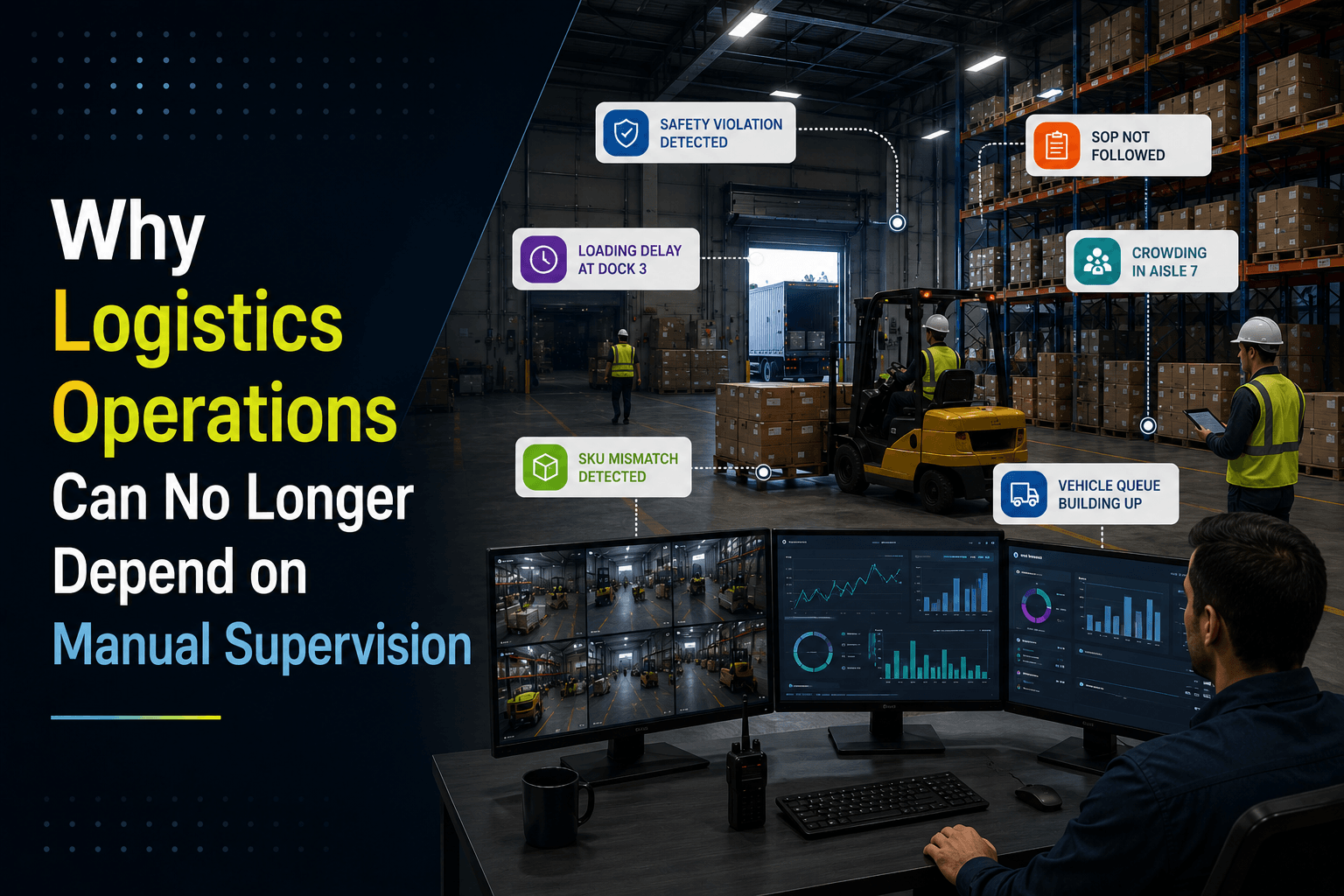
These applications can improve compliance, safety, visibility and administrative efficiency. They can reduce dependence on manual supervision and give plant teams better operational data.
But there is an important difference between creating visibility and preventing financial loss, saving time on attendance is useful, identifying an intrusion immediately is useful, measuring idle time is useful, and finding a surface defect more consistently during final inspection is certainly useful.
But if that surface defect originated several production stages earlier, much of the financial damage has already occurred.
For wind blade manufacturers, some of the largest avoidable quality costs arise when a blade requires significant rework, repair or, in the worst case, rejection after substantial material, labor and production capacity have already gone into it.
That is where manufacturing automation needs to move beyond monitoring the factory and start protecting the manufacturing process itself.
A finished-blade defect is already an expensive event
Wind turbine blades are massive composite structures built through a sequence of tightly controlled processes. Glass ply selection and placement, orientation, resin infusion, curing, bonding and numerous other production steps can ultimately affect blade quality.
A small deviation early in this process can become far more expensive once production moves forward. For example, if a glass ply is incorrectly positioned, the ideal time to identify the problem is while that ply can still be corrected, not after infusion. And if resin flow is incomplete or uneven, the ideal time to identify the deviation is while intervention is still possible, not after curing. Similarly, if adhesive application contains gaps or inconsistencies, the best time to respond is during gluing, not after the blade structure has progressed to the next stage.
Research has identified manufacturing-origin flaws as an important contributor to wind blade reliability, while the U.S. Department of Energy has also highlighted manufacturing-process flaws as an important factor in blade reliability. This is the fundamental economic difference between defect detection and defect prevention. Detection tells you that value has already been lost, while prevention gives you an opportunity to protect that value.
And that is where AI-powered blade inspection manufacturing starts delivering a fundamentally different ROI.
Why post-production inspection alone cannot solve the ROI problem
Post-production inspection remains utterly essential. AI-based surface inspection can make final checks faster, more consistent and better documented. It can help identify cracks, surface irregularities and other visible quality issues before a finished blade leaves the plant.
But it is still a downstream control.
Imagine discovering an avoidable defect after hours of production effort have already gone into the blade. Even if the blade can be repaired rather than rejected, the manufacturer may still face additional labor, material consumption, retesting, blocked production capacity, delivery delays and disruption to first-pass yield.
Published research describes wind blade repair and maintenance as a significant cost area, with blade defects potentially creating substantial downtime and repair expense. This is why AI-powered blade inspection manufacturing should not simply mean adding a smarter camera at the end of the line. The higher-value model is continuous quality verification while the blade is being manufactured.
Move AI from “watching the factory” to “protecting the blade”
The next stage of manufacturing automation is not simply adding more dashboards and alerts. It is connecting Vision AI to the stages where blade quality is actually being created. That is the model behind Orbit by Assert AI.
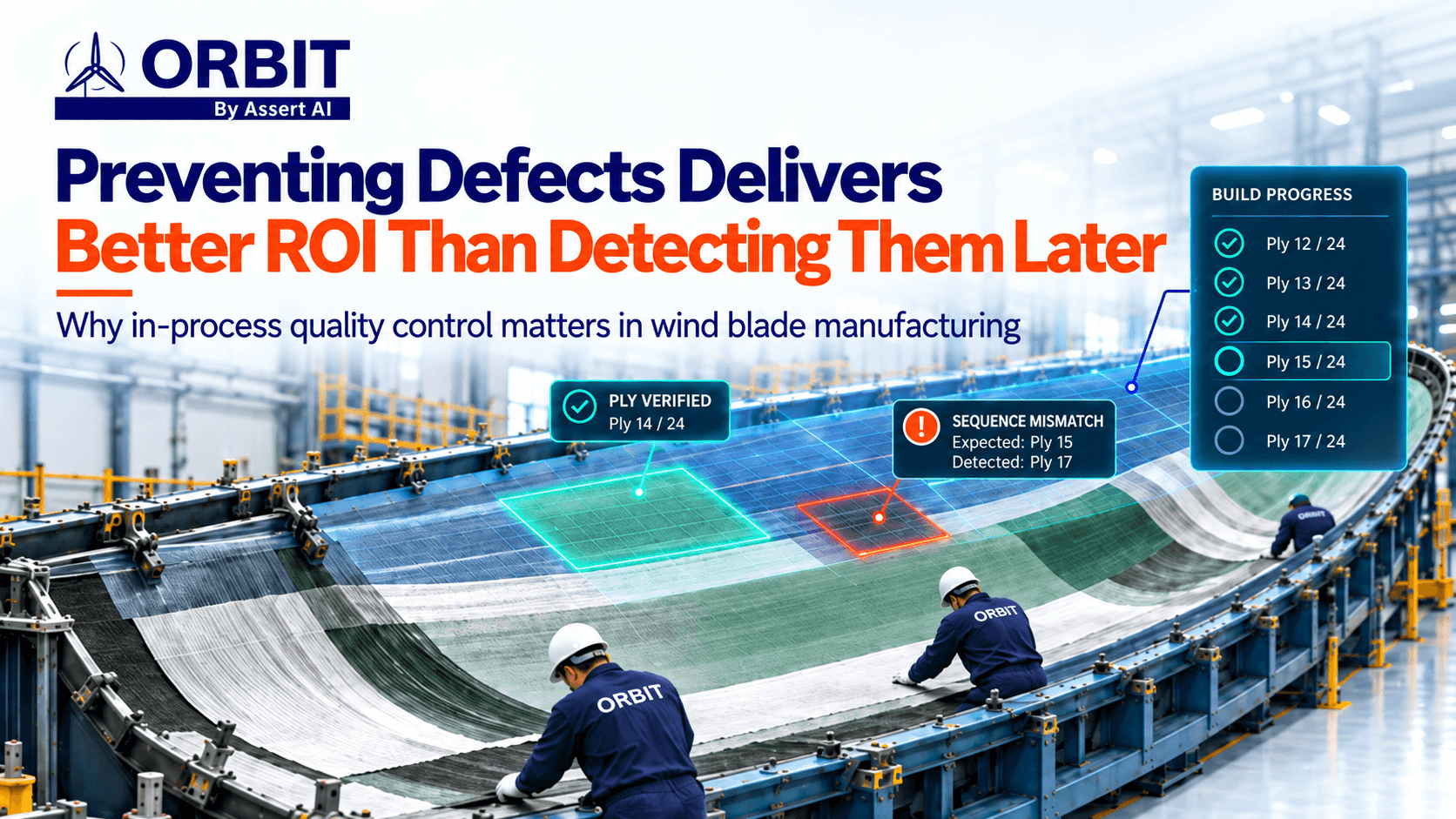
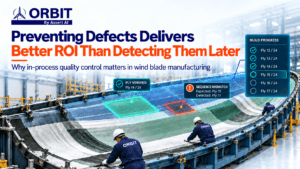
Orbit applies Vision AI to critical stages of wind blade production, including glass ply layup monitoring, resin infusion tracking, gluing process monitoring, productivity and cycle-time analysis, and EHS compliance.
Instead of waiting to ask:
“Did we manufacture a defective blade?”
Manufacturers can begin asking much earlier:
- Is the correct ply being placed?
- Is its position and orientation correct?
- Is the intended production sequence being followed?
- Is resin progressing as expected?
- Is adhesive application continuous and correctly positioned?
- Has a detected deviation actually been corrected?
- Is it safe to allow the process to move to the next stage?
That shift from retrospective inspection to active process verification is where AI-powered blade inspection manufacturing becomes a production-control capability rather than simply an inspection capability.
The ROI hierarchy for Vision AI in a wind blade factory
There is nothing wrong with using AI for employee attendance, intrusion detection, PPE monitoring, safety or productivity analytics. In fact, manufacturers can ultimately use Vision AI across all of these applications. The critical issue is where to start and what to prioritize.
Think of Vision AI value in three levels.
Level 1: AI improves visibility
The system tells you who entered an area, whether PPE was worn, when a process started, how long a workstation remained idle, or how people and materials moved through the plant.
Useful? Absolutely.
Transformational to blade manufacturing economics? Not necessarily.
Level 2: AI improves detection
The system detects a surface defect, quality exception, unsafe action or process anomaly faster and more consistently than periodic manual checks.
The financial value increases because teams can respond faster.
Level 3: AI changes the production outcome
This is where manufacturing automation becomes much more powerful. The system identifies a deviation early enough for the operator or process to correct it before more value is added to a defective state.
That is the point at which AI-powered blade inspection manufacturing can move from operational convenience to direct protection of manufacturing yield and margins.
Every defect has a “cheapest moment” to fix it
There is a simple question manufacturers can use when evaluating an AI application:
At what point does the system identify the problem?
For a layup error, the cheapest moment is before the next critical process begins.
For a resin-flow issue, the cheapest moment is while corrective action remains possible.
For a gluing deviation, the cheapest moment is before bonding is completed and the assembly progresses.
For an end-of-line surface defect, that cheapest moment may already have passed.
This does not make final inspection unnecessary.
It means final inspection should be the last layer of quality assurance, rather than the first time a preventable production deviation becomes visible. A more useful definition of AI-powered blade inspection manufacturing therefore includes not only inspecting the blade, but continuously validating how the blade is being made.
Orbit: Vision AI built around the manufacturing process
Orbit is designed to work where wind blade quality is actually created.
Visual inputs from production-floor cameras can be processed on-premise using GPU hardware to support real-time decisions, while video data remains within the client facility. The system can also build step-wise digital evidence for quality verification and integrate with production workflows and digital interlocks where required.
In practical terms, the model is straightforward:
- Cameras continuously observe the process
Rather than depending entirely on intermittent human inspection, critical manufacturing steps can remain under continuous visual verification.
- Vision AI understands the expected condition
The system evaluates what is happening against the correct process condition, sequence, placement or production requirement.
- Deviations are identified immediately
An incorrect placement or process anomaly does not have to wait until the next quality checkpoint to be discovered.
- Teams can correct the issue
The operator receives actionable information while the deviation can still be resolved economically.
- The correction can be re-verified
Instead of assuming the problem has been corrected, the system can verify the process condition before production moves forward.
- A digital quality trail is created
Visual evidence and process information create stronger traceability for quality teams, audits, root-cause analysis and continuous improvement.
This makes manufacturing automation an active quality layer inside production instead of a passive monitoring layer around it.
Safety and productivity still matter, just not in isolation
A wind blade plant should absolutely use AI to improve occupational safety and productivity wherever the business case makes sense.
PPE monitoring can reduce dependence on sporadic supervision, intrusion detection can help protect hazardous and restricted areas. Real-time alerts can accelerate response to unsafe behavior, and cycle-time analysis can reveal delays, idle periods, bottlenecks and rework loops.
Orbit itself extends into productivity, cycle-time and EHS monitoring alongside its quality-control capabilities. The difference is that these functions can sit alongside intelligence focused directly on product quality. A manufacturer does not necessarily need five disconnected AI experiments producing five different dashboards. It needs an AI strategy connected to the economics of production.
If repair, rework, rejected output, poor first-pass yield and valuable production capacity being consumed by preventable quality deviations represent the largest financial leakage, then the manufacturing automation roadmap should begin there.
That is also why AI-powered blade inspection manufacturing should be evaluated in terms of prevented defects and protected yield, not merely the number of events an AI camera can detect.
From finding defects to preventing them
Traditional quality control asks:
“Is this blade acceptable?”
A smarter production system also asks:
“Is the process currently creating an acceptable blade?”
That is a much more valuable question.
When quality intelligence operates during layup, infusion, gluing and other critical stages, manufacturers gain an opportunity to intervene before an error becomes a repair. Before a repair becomes a major rework exercise, affects throughput, and before a severe deviation risks becoming a rejected blade.
For operations and quality leaders, AI-powered blade inspection manufacturing therefore becomes less about replacing inspectors and more about giving teams continuous process intelligence that human inspection alone cannot practically provide.
Ask a better question before investing in manufacturing AI
When evaluating manufacturing automation, manufacturers should stop asking only how many activities AI can monitor.
Instead, ask:
Which failure costs us the most?
At what point does that failure first become detectable?
Can AI identify it before the next irreversible or expensive manufacturing step?
Can the operator receive an actionable alert immediately?
Can the system verify that the correction was actually made?
Can we create a digital quality record of every critical stage?
Those questions produce a very different AI roadmap.
They move investment away from “interesting things cameras can detect” and toward measurable manufacturing outcomes: stronger first-pass yield, fewer avoidable repairs, reduced rework and scrap, stronger process compliance, more predictable cycle times and better utilization of valuable production capacity.
That is the real business case for AI-powered blade inspection manufacturing.
The future of blade inspection is prevention
Wind blade manufacturers will continue to use AI for surface inspection, attendance, safety, security, productivity and many other factory-wide applications.
They should, but the bigger opportunity lies deeper in the manufacturing process.
AI-powered blade inspection manufacturing should help prevent defects from being built into the blade in the first place. That means using Vision AI when glass plies are being laid, when resin is flowing, when bonding is taking place and when manufacturing teams can still influence the outcome.
The most valuable camera in a wind blade factory may not be the one that finds a defect fastest after production, it may be the one that helps prevent that defect from being created at all. That is where manufacturing automation starts producing a different class of ROI.
And that is exactly where Orbit by Assert AI is designed to operate.