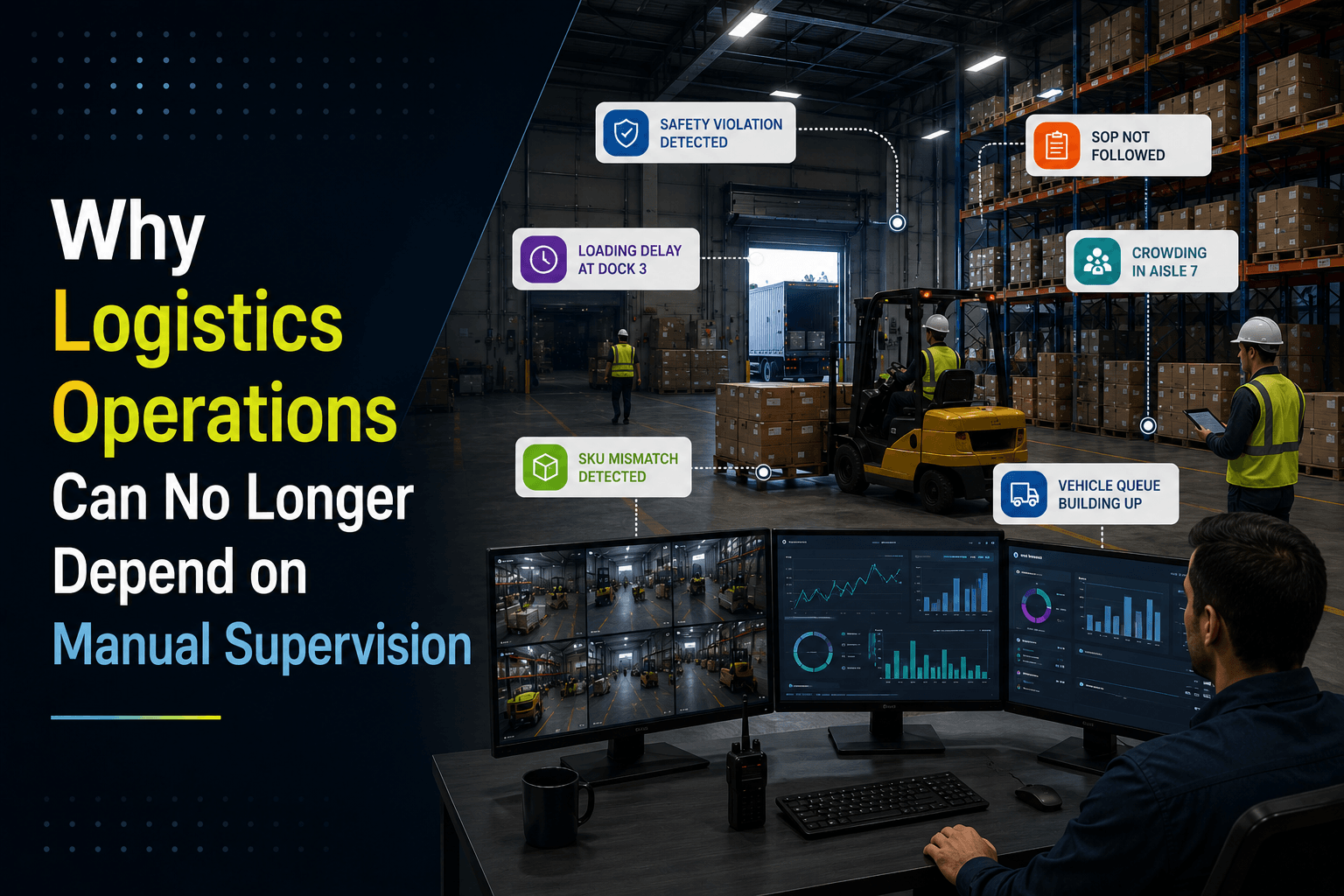
For years, warehouses have run on the same model: supervisors monitoring workflows, enforcing safety standards, and resolving issues as they arise. It worked when facilities were smaller, and operations were simpler.
Today, that model has a ceiling. Facilities are bigger, shift volumes are higher, and the pace of movement leaves less margin for the delays that manual oversight routinely misses. AI for logistics doesn’t replace the supervisory layer- it gives it the visibility it was never able to have on its own.
Why Is Manual Supervision Reaching Its Limits?
A single supervisor managing multiple loading docks, storage zones, and dispatch areas cannot physically monitor everything at once. That’s not a capability issue- it’s a structural one. Attention is finite, and coverage has gaps. And in a high-throughput warehouse, gaps have consequences.
With business growth, businesses always face:
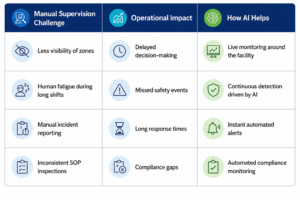
- Delays in detecting workflow disturbances before they escalate
- Not reporting safety incidents until they escalate to serious situations
- Failure to follow standard operating procedures shift to shift
- Underutilized staff and idle equipment that no one can see
- Little operational oversight of multiple warehouse zones at once
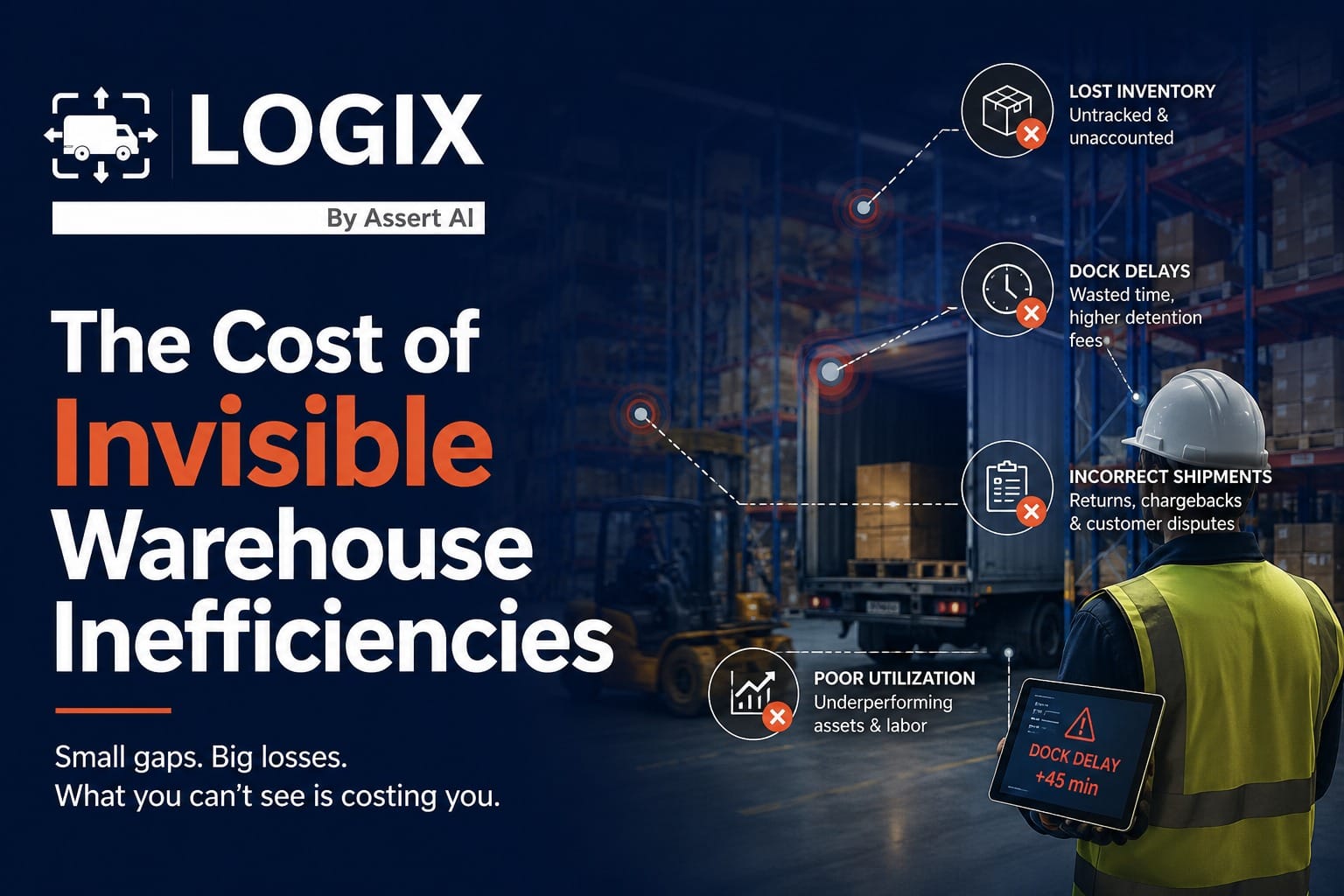
These gaps don’t lead to instant failures. They pile up, slowly eroding efficiency and raising costs in ways that are hard to trace back to a single cause.
What Operational Blind Spots Are Costing Logistics Teams?
Most warehouse inefficiencies aren’t dramatic. They’re small deviations -a loading bay running three minutes behind standard, an SOP step skipped during peak hours, a vehicle queuing because dock allocation wasn’t optimised in real time. Manual monitoring catches some of these. It misses many more.
Identifying these blind spots sooner enables logistics teams to react before small problems impact productivity or customer commitments.
How Does AI for Logistics Improve Operational Visibility?
Logistics AI leverages computer vision to analyze live video streams from existing CCTV cameras, with no new hardware or overhaul of a facility needed. Operations teams have constant insight into all monitored zones without increasing headcount.
AI-powered monitoring can help logistics teams:
- Spot safety violations in real-time, not after the fact
- Recognize bottlenecks at loading and unloading points as they occur
- Monitor vehicle flow and dock activity for all shifts
- Stop workflow interruptions before they become bigger delays
- Create operating insights that drive decisions, not just capture results
Solutions by Assert AI leverage the existing general purpose camera infrastructure, so businesses can get meaningful visibility without replacing what they already have.
Where Does Warehouse Automation Deliver the Greatest Value?
Typically, warehouse automation is thought to be robotics and automated storage systems. Automation, however, also applies to the way operational decisions are made, and this is where AI-driven monitoring delivers frequently underestimated value.
AI-enabled warehouse automation helps in:
- Real-Time Dock Data for Faster Dispatching Operations
- Less manual intervention for a smoother inventory flow
- Reducing waiting time of vehicles at loading bays
- Allocation of resources for each shift more accurately
- More consistency of operations regardless of shift or supervisor
The AI does not replace the warehouse teams, but gives the supervisors the opportunity to spend less time searching for problems and more time solving them.
Why Workforce Intelligence Matters More Than More Supervisors
Adding supervisors addresses headcount- it doesn’t solve the data problem. As warehouses expand, what operations leaders need isn’t more people watching the floor. It’s better information about what’s happening on it.
Workforce Intelligence converts operational activity into structured data, allowing managers to:
- Understand how teams perform across different shifts
- Identify where recurring delays are consistently originating
- Monitor productivity trends over time rather than shift by shift
- Make staffing decisions based on evidence rather than observation
Platforms like Assert AI translate everyday warehouse activity into operational insight- moving supervisors from reactive monitoring toward continuous, data-driven improvement.
Smarter Visibility Is Becoming a Competitive Advantage
Modern logistics operations generate more activity than manual supervision can effectively manage alone. That’s because as facilities grow and customer expectations rise, companies are looking for more visibility into daily operations, without increasing supervision costs.
AI for logistics bridges this gap by upgrading existing camera systems into intelligent monitoring tools. It provides faster decision-making, more consistency across warehouse operations, and improved operational efficiency, as well as workforce intelligence and warehouse automation.
For logistics leaders building more resilient operations, smarter visibility is no longer optional; it’s becoming the baseline.
FAQs
1. What is AI for logistics?
AI in logistics employs computer vision and analytics to monitor warehouse operations in real time, giving you the visibility to make fast, smart decisions.
2. How does warehouse automation increase efficiency?
Automation is not only robotics, but it is also about decision-making. With real-time data on dock efficiency, workflow compliance and resource allocation, management can make quicker, more consistent decisions across all shifts.
3. What is Workforce Intelligence in logistics?
Workforce Intelligence converts actions into structured data so management can understand what the staff is doing, how well it’s being done, how productive it is and what inefficiencies are recurring – without having to see it for themselves.
4. How does Assert AI help logistics operations?
Assert AI leverages computer vision and existing CCTV technology to provide real-time monitoring, safety and compliance detection without the need for additional hardware or changes to facilities.