The Renewable Energy Boom and the Hidden Quality Risk
Wind energy capacity is expanding at an unprecedented pace worldwide, fueling the transition to clean power. Yet, this rapid growth masks a hidden risk: manufacturing quality failures at scale. Pressure to accelerate installations, reduce costs, and meet aggressive targets has exposed vulnerabilities in the production of critical components like wind turbine blades.
According to the Global Wind Energy Council (GWEC), global wind capacity surpassed 1 terawatt in 2023, and annual installations are expected to exceed 120 GW per year by 2030. While this rapid expansion is essential for the energy transition, it is also exposing a less-discussed vulnerability: manufacturing quality failures at scale.
Wind turbines are massive, complex machines designed to operate reliably for 20–25 years. But when manufacturing quality falters, the consequences can be severe ranging from costly repairs to structural failures that threaten safety and project economics.
A striking example emerged in February 2026, when a large wind farm in Chifeng, Inner Mongolia, operated by China Three Gorges Renewables, reported widespread wind turbine blade defects. Nearly two-thirds of the turbines at the facility required blade repairs, even though the turbines had been installed only nine years earlier.
The incident highlights a critical issue facing renewable energy manufacturing today:
Traditional quality management approaches are no longer sufficient for large-scale industrial production.
As manufacturing complexity grows, AI in quality management is emerging critical to detect defects early, improve traceability, and ensure long-term reliability.
The Wind Blade Defect Crisis in China
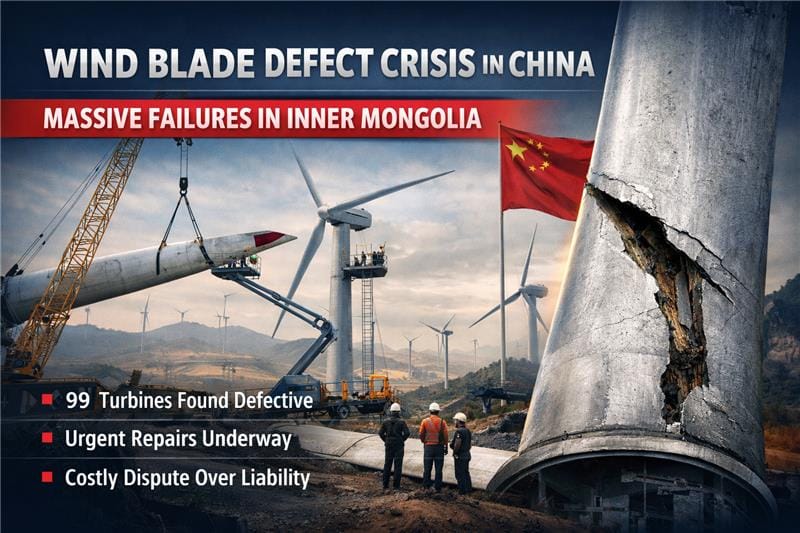
In early 2026, China Three Gorges Renewables issued a maintenance tender after discovering massive, “serial” defects across a large wind farm in Chifeng, Inner Mongolia.
The facility is a 300-MW wind project consisting of 150 wind turbines installed around 2016. However, inspection results revealed a significant reliability issue.
Key Findings from the Investigation
- 150 turbines installed
- 99 turbines identified with blade defects
- 138 blades require factory-level repair
- 102 blades require tower-top repair
- 57 blades require ground-level repairs
- 15 blades must be completely replaced
Considering each turbine typically has three blades, the scale of the problem is substantial.
To address the crisis, China Three Gorges initiated a formal procurement and maintenance process. This included a tender for repairs and evaluation of liability disputes among turbine manufacturers and component suppliers.
The turbines were designed for a 20-year operational lifespan, yet the defects appeared after only nine years, forcing operators to undertake expensive maintenance campaigns.
For wind farm operators, this means:
- Unexpected downtime
- High repair and replacement costs
- Potential insurance and legal disputes
- Reduced energy generation revenue
But the deeper issue goes beyond a single wind farm. It exposes systemic problems in wind turbine manufacturing quality control.
Why Do Quality Failures Happen in Wind Turbine Blade Manufacturing?
Wind turbine blades are among the most complex composite structures produced in modern manufacturing. A single blade can exceed 80–100 meters in length, consist of multiple layers of fiberglass or carbon fiber composites, and must withstand extreme mechanical loads for years. Despite advances in engineering, quality failures still occur across the industry not due to a single issue, but because of a combination of manufacturing complexity, process variability, material inconsistencies, and gaps in quality monitoring.
A major challenge lies in the limitations of traditional inspection methods. Manual inspection of such large structures is difficult and prone to fatigue, variability, and missed defects, especially when identifying subtle inconsistencies across vast composite surfaces. Additionally, defects are often detected late after production or even post-installation leading to costly repairs and rework. The lack of end-to-end production traceability further complicates root cause analysis, as critical data like material batches, curing conditions, and bonding steps are often fragmented or manually recorded. On top of this, inconsistent quality audits and the absence of real-time monitoring mean that process deviations during manufacturing can go unnoticed, allowing defects to propagate through the production lifecycle and eventually impact long-term blade performance.
The Cost of Quality Failures
When defects escape manufacturing and appear in the field, the consequences can be enormous.
According to industry studies, operations and maintenance (O&M) costs represent up to 25–30% of total wind farm lifecycle costs.
Early failures increase costs through:
- blade repairs and replacements
- crane mobilization expenses
- lost electricity production
- safety risks for technicians
- legal and insurance disputes
For large wind farms, a single blade failure can cost hundreds of thousands of dollars to repair. When dozens of turbines are affected, the financial impact can reach tens of millions of dollars.
How AI is Transforming Quality Management
To address these challenges, manufacturers are increasingly adopting AI in manufacturing quality inspection.
AI-powered quality management systems combine computer vision, machine learning, and data analytics to monitor production processes in real time.
Instead of relying on periodic inspections, AI systems provide continuous quality monitoring across manufacturing stages.
Key Capabilities of AI-Driven Quality Managemen
- Real-Time Defect Detection
AI vision systems analyze high-resolution images and video streams directly from the production line to detect defects during manufacturing. These systems can identify issues and structural inconsistencies much earlier than traditional inspections, allowing manufacturers to address problems before they progress further in production.
- Predictive Quality Monitoring
Machine learning aggregates and analyzes data from integrated systems to uncover hidden patterns, enabling early detection of signals that may lead to potential defects.
By recognizing early warning signals, predictive systems help manufacturers anticipate quality issues before they occur, enabling preventive actions that reduce scrap, rework, and costly downstream failures.
- Digital Traceability
AI-enabled quality certification systems create a digital record of the entire manufacturing lifecycle, linking inspection results with production data. This traceability connects key information such as material batches, process conditions, and supplier data, helping manufacturers quickly identify the root cause of defects and maintain stronger quality accountability across production.
- Automated Process Monitoring
AI-driven systems move beyond traditional post-production inspection by enabling real-time monitoring of manufacturing processes. Instead of identifying defects after completion, AI continuously analyzes visual and sensor data during production, allowing issues to be detected and corrected immediately. This shift not only reduces reliance on manual inspection but also prevents defects from setting in, minimizing rework, rejections, and associated delays while improving overall quality and process control.
How Leading Wind OEMs Are Using AI to Strengthen Quality Management
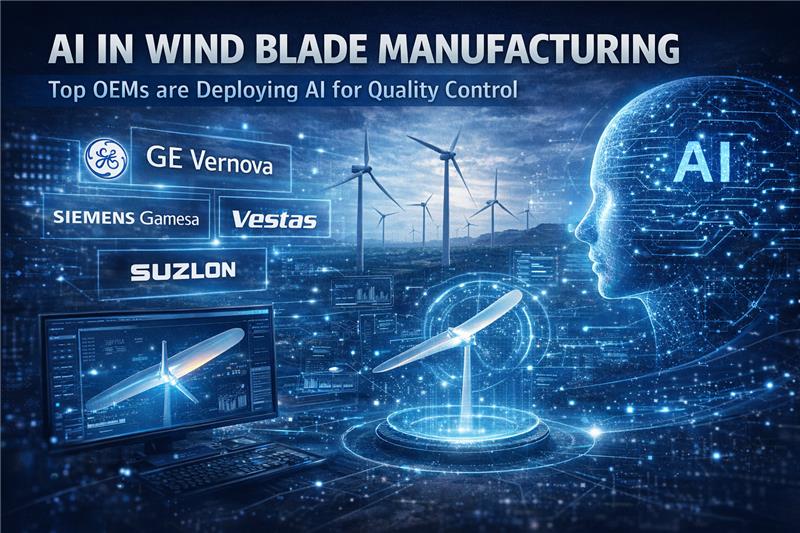
As wind turbines grow larger and blade structures become more complex, leading wind turbine manufacturers are increasingly adopting AI-driven inspection and digital quality monitoring to improve manufacturing reliability. Instead of relying only on manual inspections, OEMs are exploring AI, computer vision, and advanced analytics to enhance quality control, improve traceability, and strengthen long-term turbine performance.
GE Vernova is actively incorporating AI and advanced digital technologies into its wind manufacturing and inspection processes, with a growing focus on improving blade quality and reliability through data-driven systems.
Siemens Gamesa has been investing in AI and machine learning capabilities, particularly in inspection and analytics, as part of its broader strategy to enhance manufacturing efficiency and turbine performance.
Vestas continues to expand its digital and analytics capabilities, leveraging AI-driven insights to improve turbine monitoring, reliability, and overall operational efficiency across its global fleet.
Suzlon Energy is also moving toward AI-enabled manufacturing, with plans to integrate advanced monitoring and analytics into its blade production facilities to improve consistency and quality outcomes.
Across the industry, these developments signal a clear shift toward AI in manufacturing quality inspection and predictive quality monitoring, as leading OEMs recognize the need for smarter, more scalable approaches to quality management in large-scale renewable energy production.
The Future of Quality Management in Renewable Manufacturing
As wind turbines grow larger and composite manufacturing becomes more complex, ensuring consistent quality across production is becoming increasingly challenging. Traditional inspection methods alone are no longer sufficient to detect defects early or maintain full visibility into manufacturing processes. This is why the industry is gradually shifting toward AI-driven quality monitoring and predictive inspection systems. These systems enable real-time process visibility, early defect detection, and stronger production traceability.
Platforms like ORBIT by Assert AI are helping manufacturers make this transition by bringing AI-powered visual monitoring and process verification directly into composite manufacturing environments. By integrating with industrial systems and laser projection technologies, ORBIT enables manufacturers to verify execution, detect anomalies earlier, and build reliable digital records across critical production stages.
As renewable energy infrastructure continues to scale, AI-driven quality management will play a key role in ensuring reliability, safety, and long-term performance in advanced manufacturing sectors like wind turbine production.
FAQs: Wind Turbine Blade Defects and AI in Quality Management
- What caused the recent wind turbine blade defect incident in China?
The incident in China was primarily linked to manufacturing and quality control issues, where defects in blade production went undetected during manufacturing. These defects surfaced 9 years later, leading to repairs and replacements much earlier than the expected turbine lifespan.
- Have similar wind turbine blade failures happened before in China and globally?
Yes, wind turbine blade defects and failures have been reported both in China and globally over the years. Most cases are linked to composite manufacturing issues, material inconsistencies, or process gaps, especially during periods of rapid industry expansion.
- What are the main causes of wind turbine blade defects?
The most common causes include material variability, poor bonding, lamination defects, fiber misalignment, and lack of real-time quality monitoring. These issues often originate during manufacturing but may only appear after prolonged operational stress.
- Why are wind turbine blade defects difficult to detect?
Blades are made of layered composite materials, making many defects internal and not visible on the surface. Traditional inspection methods are limited in detecting such hidden issues, especially across very large structures.
- How can AI help prevent wind turbine blade defects?
AI enables real-time inspection, automated defect detection, and predictive quality monitoring during manufacturing. It helps identify anomalies early, ensure correct process execution, and prevent defects from progressing to later stages or field deployment.
- Why is AI important for quality management in wind energy?
As turbines become larger and more complex, traditional inspection methods are no longer sufficient. AI provides continuous monitoring, better traceability, and higher inspection accuracy, making it essential for ensuring long-term reliability and reducing costly failures in wind energy projects.