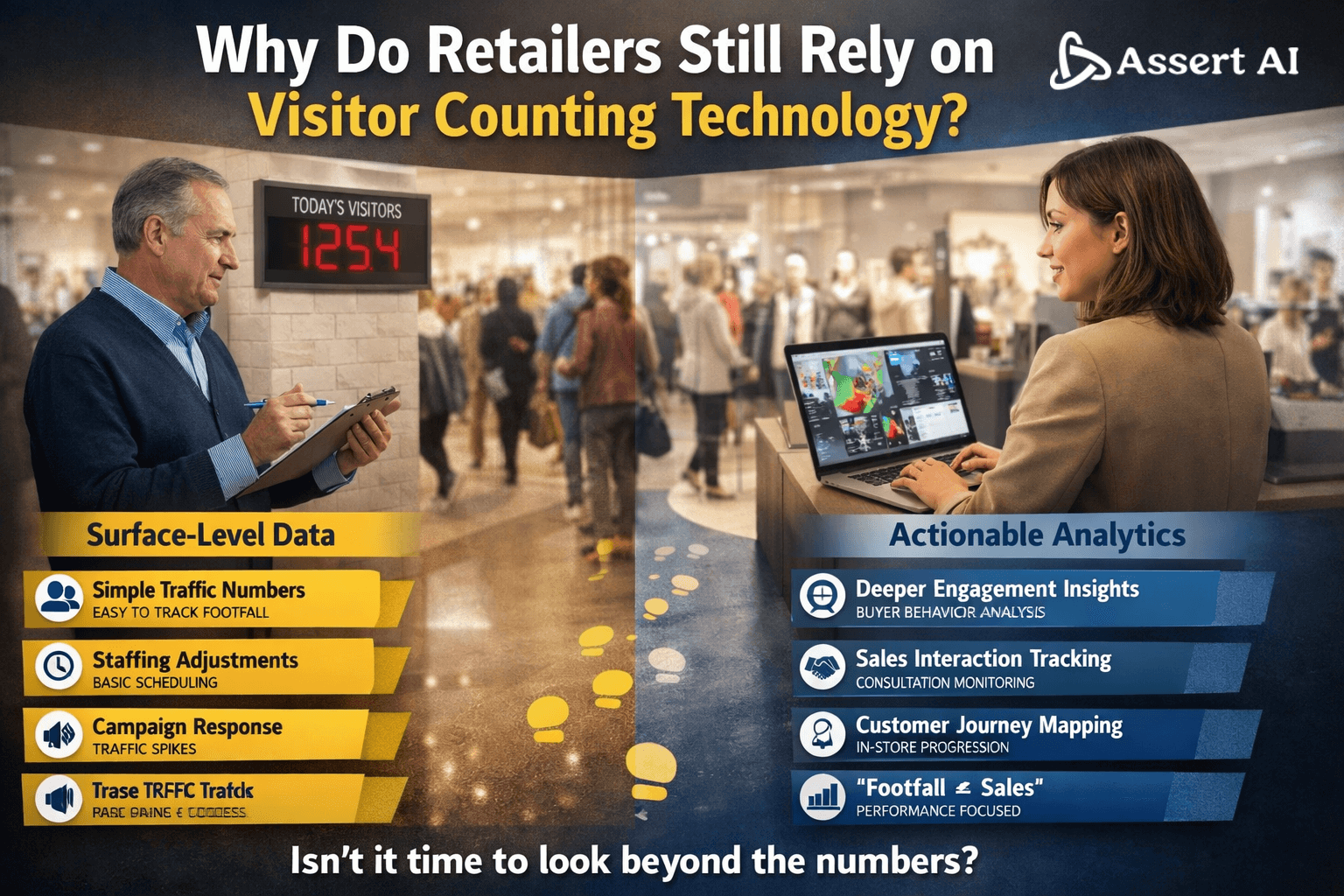
Many retailers rely on a single metric to measure success, but relying solely on visitor volume is often insufficient. High entry numbers rarely reflect true showroom success on their own.
In fact, reports show that store traffic is increasingly volatile, and conversion rates can remain stagnant despite crowded aisles. This discrepancy proves that footfall is just a surface-level figure. To gain true clarity, modern businesses must transition toward deeper showroom analytics.
At Assert AI, we understand that raw data needs context to be useful. We provide sophisticated tools that help retailers interpret activity beyond simple counting, allowing managers to identify serious buyers.
Why Do Retailers Still Rely on Visitor Counting Technology?
For many decades, visitor counting technology served as the primary tool for measuring retail success. It gained widespread popularity because it represented the first major step away from “gut feelings” toward data-driven management. However, continuing to rely on these basic systems today reveals several visitor counting limitations that can hinder growth.
- Historical simplicity: In the past, the technology offered retailers a very easy, low-cost way to measure store traffic without needing complex IT setups.
- Operational visibility: These traffic counts gave management a simple signal of store activity. As a result, they could adjust staffing levels for different hours of the day.
- Marketing campaign evaluation: Retail teams traditionally linked their promotional efforts to traffic spikes. If the numbers went up, they assumed the advertisement was a total success.
- Early retail analytics limitations: Earlier retail systems lacked the sophisticated sensors required for deeper behavioral analysis or movement tracking.
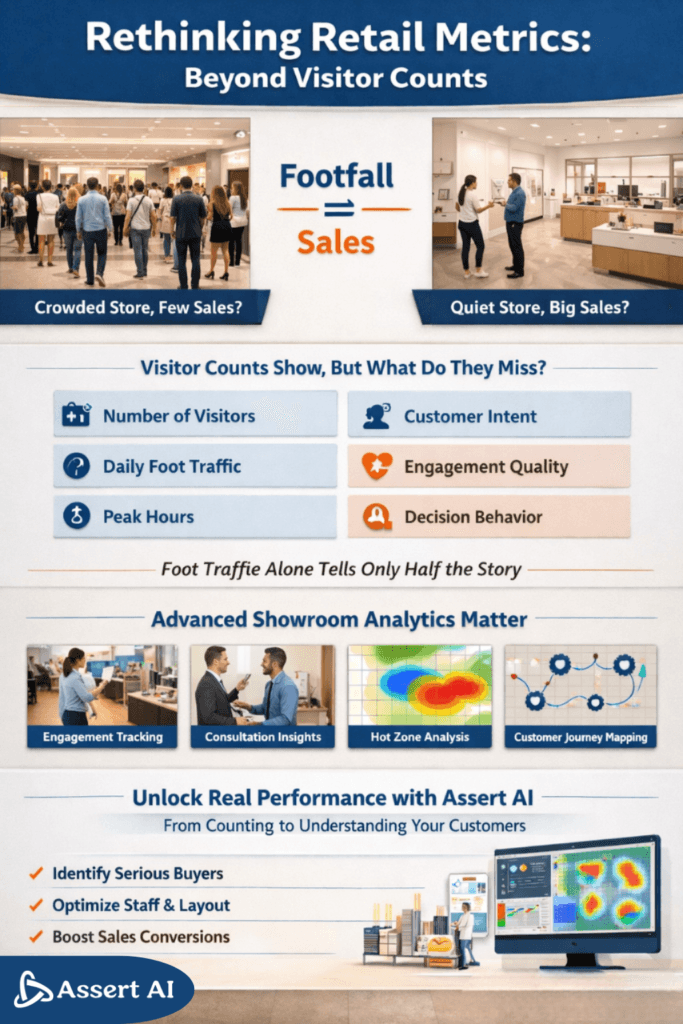
What Do Visitor Counts Fail to Reveal About Showroom Performance?
While general traffic trends provide a basic baseline, they completely miss the nuances of retail showroom effectiveness. For example, a high volume of entries can actually mask deeper operational issues like poor customer service, long wait times, or confusing floor layouts that frustrate potential buyers.
The following table shows the key measurement blind spots created when retailers rely only on entry data instead of using full showroom performance metrics.
Shifting focus from simple quantity to the quality of each interaction helps managers identify precisely where the customer journey breaks down. Using advanced data bridges the gap between seeing a crowd and understanding a customer.
| Visitor Counts Show | What They Fail to Explain |
| Number of people entering the showroom | Customer intent or purchase readiness |
| Daily traffic patterns | Engagement with specific product displays |
| Peak store hours | Interaction quality between visitors and sales teams |
| Basic traffic trends | Decision-making behavior inside the showroom |
By analyzing these gaps, businesses can get a clearer view of what is really happening in their showroom. A broader approach helps teams improve how the space is used. Every square foot can then support conversions, not just occupancy.
Why Does Footfall vs Performance Create Misleading Conclusions?
The analytical relationship between footfall vs performance is rarely a straight line. If a showroom is packed to capacity but the sales desk remains empty, the perceived success is largely an illusion. Measuring volume without intent leads to poor strategic decisions.
High traffic does not guarantee a strong sales performance
Busy showrooms can attract visitors who are simply exploring options or “showrooming” for online purchases. If you only look at the volume of footfall, you might assume the store is thriving while actual revenue remains stagnant.
Low traffic may still produce strong results
Conversely, luxury showrooms can convert fewer visitors into much higher-value purchases. If those few visitors engage deeply, the store is highly successful. In this scenario, the volume is low, but the effectiveness is at its peak.
Why the principle “Footfall ≠ Sales” matters in showroom evaluation
Retail teams may assume that more visitors automatically translate into stronger revenue. Relying on that assumption leads to skewed performance reviews. Acknowledging that Footfall ≠ Sales helps management avoid penalizing teams who prioritize quality interactions over quantity.
Which Metrics Actually Reflect Retail Showroom Effectiveness?
To move past footfall analytics limitations, retailers should adopt more sophisticated showroom analytics. These modern indicators provide a clearer picture of retail showroom effectiveness. They focus on what happens after a person enters. Relying on simple entrance data can leave managers in the dark about actual customer sentiment. By using deeper metrics, businesses can finally understand the nuances of the in-store experience.
Customer engagement duration
The amount of time a visitor spends interacting with a product reveals a much deeper purchase intent than a quick walkthrough. Longer dwell times usually signal a genuine interest in specific features or pricing.
Sales consultation frequency
Tracking how often visitors engage with sales advisors shows the quality of the lead and the proactiveness of the staff. This helps identify if your team is effectively capturing opportunities.
Showroom interaction zones
Understanding exactly where visitors spend their time helps you evaluate if your current layout is actually working. You can see which displays are magnets and which are being ignored.
Customer journey progression
Observing how visitors move from the exploration phase to a formal consultation highlights real engagement levels. This maps the path from curiosity to a potential sale.
Decision-stage behavior signals
Certain behavioral patterns, such as returning to the same display multiple times, indicate a very serious purchase consideration. These signals allow for timely interventions to close a deal.
How Does Assert AI Turn Showroom Analytics Into Actionable Performance Insights?
Modern AI systems are now capable of analyzing complex showroom behavior rather than simply counting visitors at the door. We specialize in converting standard video feeds into a goldmine of information by applying sophisticated algorithms to existing infrastructure. By using advanced computer vision, we help businesses overcome standard visitor counting limitations by looking at specific actions, not just presence. This transition allows for a nuanced understanding of the customer journey that traditional sensors simply cannot provide.
Behaviour recognition through video analytics
Our AI systems detect patterns such as browsing behavior, engagement zones, and consultation moments, offering deep showroom analytics.
Real-time operational insights
Store managers gain immediate visibility into showroom activity. This allows them to move staff to “hot zones” the moment traffic increases.
Performance evaluation beyond visitor numbers
Retailers can finally interpret showroom performance metrics more accurately. This leads to better training and improved store designs.
When Should Retailers Rethink Footfall as a Performance Indicator?
It is time for your organization to look beyond the front door when traditional data stops making sense. Heavy reliance on footfall can hide deeper insights. Retailers should recognize visitor counting limitations when traffic numbers look strong, but sales, engagement, and customer behavior inside the showroom tell a different story.
- Visitor counts remain stable, but sales fluctuate without clear external factors. This usually means traffic numbers are not connected to actual purchase intent.
- Showroom engagement appears inconsistent with the high traffic numbers reported. Visitors may enter the store but spend very little time interacting with products or staff.
- High visitor activity does not translate into consultations or lead generation. This usually signals weak customer intent or poor engagement within the showroom space.
- Marketing campaigns increase traffic without improving the actual conversion behavior of those visitors. In such situations, footfall grows, yet meaningful outcomes remain limited due to ongoing visitor counting limitations.
Conclusion
Relying on visitor numbers alone cannot explain the true success of a modern showroom. It is a surface level metric. It may hide issues in the customer journey. To thrive in a competitive market, you must focus on deeper showroom performance metrics. While footfall gives a starting point, behavioral data drives revenue. With strong showroom analytics, you can see the real reason behind every visit.
At Assert AI, we are at the forefront of the computer vision revolution, providing businesses with the power to transform video data into actionable intelligence.
Ready to see what’s really happening in your showroom? Contact us today for a demo.
Frequently Asked Questions
1. Is visitor counting enough to measure showroom performance?
Visitor counting only measures traffic volume. It does not reflect engagement quality. Real performance requires deeper showroom performance metrics to track intent, overcoming visitor-counting limitations.
2. What are the main limitations of visitor counting technology in retail showrooms?
Visitor counting technology measures entries only. It cannot track customer intent or engagement. It also does not reveal browsing patterns or consultation activity.
3. How does footfall differ from actual showroom performance?
Traffic measures the quantity of visitors. Performance depends on engagement, consultation, and purchase behaviour. Understanding footfall vs performance helps retailers identify if they are converting visitors.
4. What metrics should retailers track instead of relying only on visitor counts?
Retailers should track engagement duration and consultation interactions. Showroom analytics gives behavioural insights that help measure retail showroom effectiveness in a clearer way.
5. How do modern analytics systems improve showroom measurement?
AI-driven behavioural insights give a deeper understanding of visitor activity. These systems help managers see footfall analytics limitations clearly. They also show the full customer journey inside the store.