A truck arrives at a retailer’s warehouse. The driver unloads the shipment, the receiving clerk signs the Proof of Delivery (POD) document, and the truck leaves the facility.
On paper, the delivery is complete.
But a few days later, the retailer raises a dispute. Several pallets are reported missing, and some pallets are claimed to be damaged.
The logistics team checks their documentation and finds only one record, a signed POD.
This situation is extremely common across logistics networks. A signature confirms that someone received the shipment, but it does not prove what was actually delivered, how many pallets were present, or whether the goods were in the right condition.
Logistics operators report that documentation gaps contribute to nearly 30% of shipment disputes, particularly when there is insufficient delivery evidence available during investigations highlighting the growing need for warehouse logistics solutions that provide deeper shipment visibility.
The reality is clear:
Traditional POD logistics systems built around signatures and paperwork are no longer sufficient for modern supply chains. Today, logistics leaders are shifting toward visual proof of delivery using photos, videos, and AI-driven shipment verification powered by computer vision in logistics to create indisputable evidence of what actually happened.
In modern supply chains, visual evidence is becoming more powerful than signatures.
Proof of Delivery: Reliable on Paper, Fragile in Practice
Proof of Delivery has been the industry’s default mechanism for closing shipments. A signed document, physical or digital, signals completion, triggers billing, and acts as the first line of defense in case of disputes.
Over time, this system evolved. Paper trails were replaced by structured digital records. ePOD introduced timestamps, geolocation, and faster retrieval, bringing much-needed efficiency to logistics workflows.
According to the Kaizen Institute, digitized documentation improves transparency and accountability by making records easier to access and audit. An important step toward logistics process automation AI adoption.
Research by Capgemini also shows that digital POD systems can reduce disputes by up to 80% by improving documentation quality.
On paper, the system works.
But on the ground, the story is different.
Because the core assumption hasn’t changed: a signature equals verification.
And that assumption quietly breaks down in high-volume operations.
Where the System Starts Cracking
At the point of delivery, speed wins over scrutiny.
Trucks queue up. Dock doors turn over rapidly. Receivers sign off to keep the flow moving. The shipment is marked “delivered”, often before it is fully checked, sometimes without reconciliation, and occasionally without visibility into what was actually unloaded gaps that modern warehouse logistics solutions are now trying to address.
What gets captured is a moment of acknowledgment.
What gets missed is everything that matters.
- Was the shipment complete?
- Was it the right shipment?
- Was the condition intact at handover?
By the time these questions surface, the truck has moved on, the dock has reset, and the only artifact left is a signature tied to an event, not to its accuracy.
This is why, despite better systems, disputes haven’t disappeared. They’ve simply shifted downstream into claims, deductions, and long reconciliation cycles where evidence is weak and accountability is blurred.
At scale, this is no longer a process inefficiency.
It is a systemic gap in how deliveries are verified.
From Acknowledgment to Evidence: The Rise of Visual POD
To close this gap, leading logistics operations are moving beyond signatures to something far more concrete: visual proof.
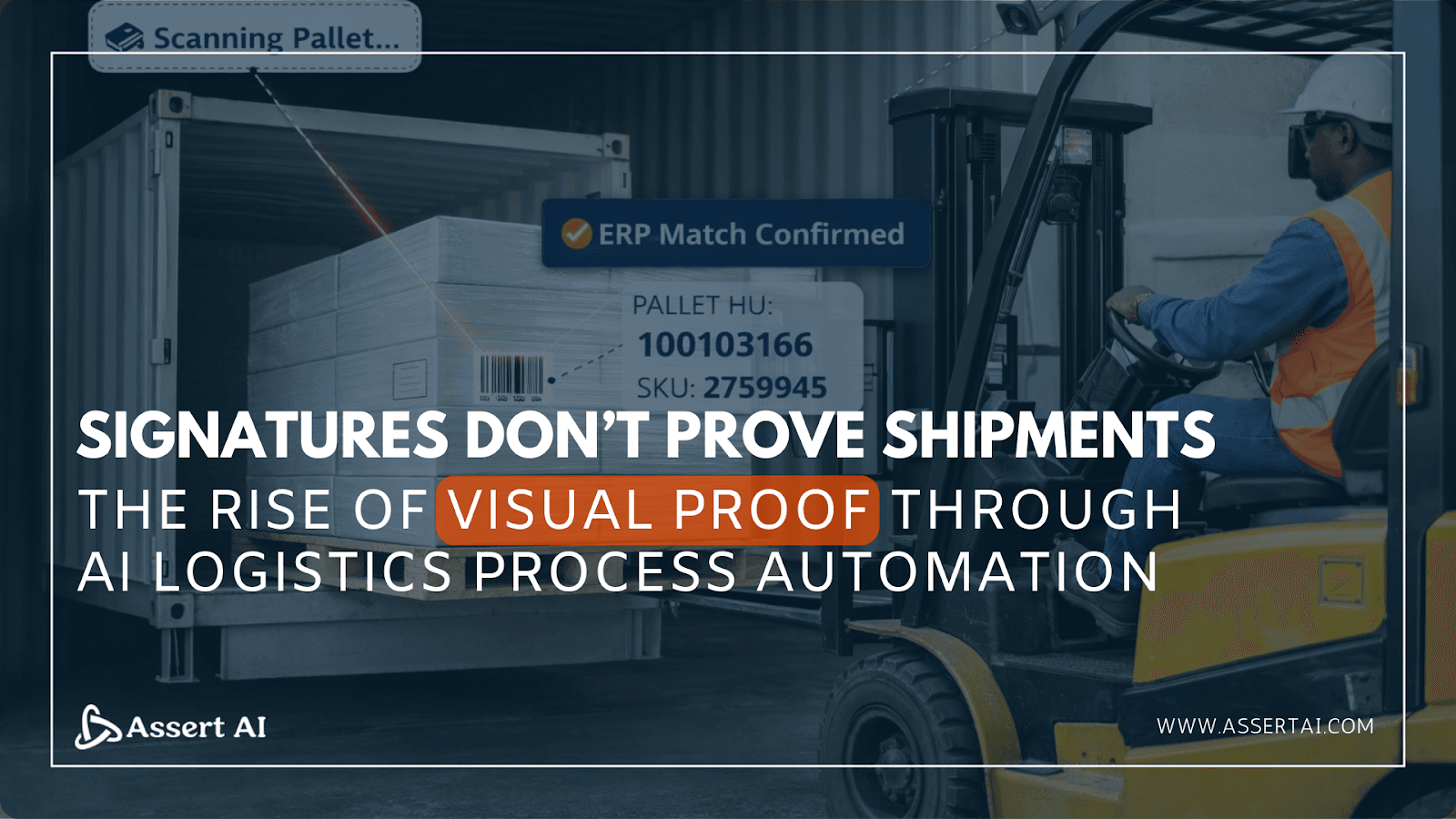
Instead of relying on acknowledgment alone, deliveries are now validated through time-stamped images and videos captured during loading, dispatch, and handover enabled by computer vision logistics systems that continuously monitor shipment activity.
This changes the nature of proof entirely.
A signature confirms that a delivery happened.
A visual record shows what was actually delivered.
With a single frame, teams can verify:
- exact pallet count
- Match pallet SKUs with PO
- packaging condition
- alignment between dispatched and received goods
This level of clarity fundamentally alters dispute resolution. What was previously debated can now be verified.
Industry data reflects this shift. Visual proof of delivery systems have been shown to reduce disputes and fraudulent claims by 70–85% by providing verifiable shipment evidence.
But the real impact goes beyond disputes.
Visual documentation creates operational visibility that never existed before. It allows teams to audit shipments, identify process gaps, and enforce consistency across loading and unloading practices making it a critical component of logistics process automation ai strategies.
In modern logistics, this is the shift underway: from signing off shipments to proving them.
How AI Platforms Like LOGIX Enable End-to-End Proof
Modern logistics verification platforms are using AI and computer vision to automate how shipments are monitored, validated, and documented at the dock.
Platforms like LOGIX leverage existing camera infrastructure to continuously observe loading activity, capturing time-stamped images and video as shipments are built and dispatched. This creates real-time visibility into what is being loaded and how it is handled, transforming traditional operations into intelligent warehouse logistics solutions.
At the same time, the platform integrates with ERP and warehouse systems such as SAP. As cartons move through the loading process, AI vision scans barcodes or SKU labels and matches them against shipment data- verifying the right SKUs, quantities, and vehicle assignment in real time.
If any mismatch occurs, instant alerts are triggered at the dock, enabling teams to correct errors before the truck leaves. Instead of discovering issues downstream, interventions happen at the point of action, when they are still fixable.
By combining visual monitoring with system validation, the platform eliminates dependency on manual checks and prevents common errors such as incorrect SKU loading, missing cartons, or wrong-truck dispatches – key benefits of logistics process automation ai.
All captured data like visual records, verified counts, and dispatch confirmations is then consolidated into a digital shipping certificate. This creates a structured, time-stamped evidence trail linked directly to enterprise records.
The outcome is straightforward: every shipment is not just recorded, but provably verified improving accuracy, strengthening accountability, and significantly reducing disputes through computer vision logistics.
Retail Compliance Is Getting Stricter — And Suppliers Are Paying the Price
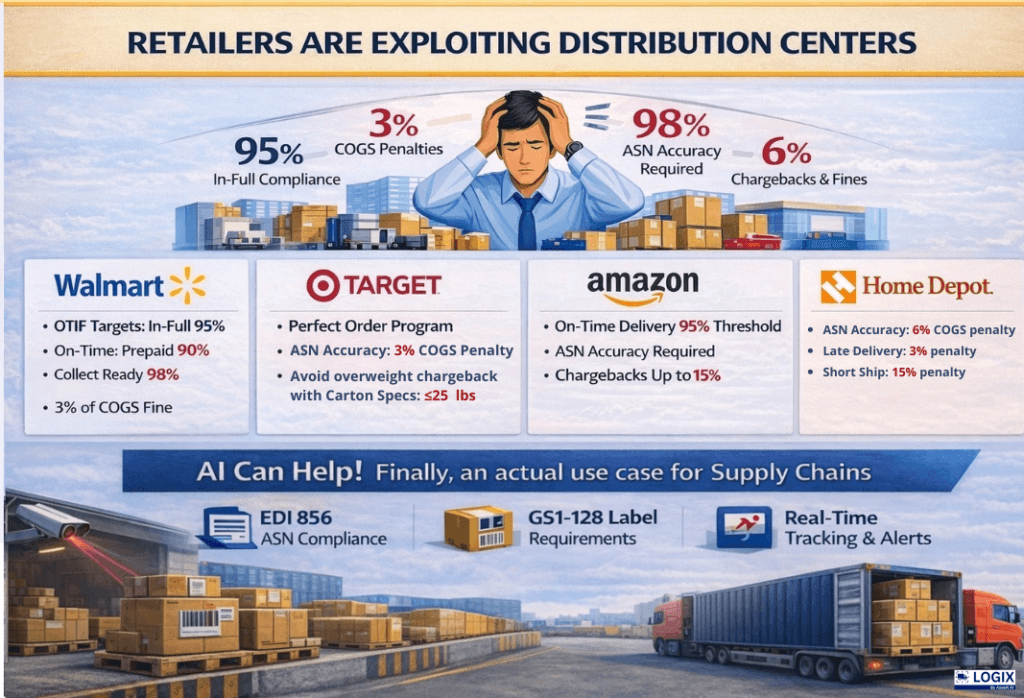
If you are a supplier working with large retailers like Amazon, Walmart, Target, or Home Depot etc., you are already operating in an environment where compliance is directly tied to financial impact. Retailers are tightening their supply chain requirements to improve inventory accuracy and shelf availability, and metrics like OTIF, ASN accuracy, labeling standards, and delivery documentation are being tracked more aggressively than ever.
This isn’t just about process anymore; even small discrepancies can lead to penalties. For instance, Amazon has increased its on-time delivery expectations from 90% to 95% in 2026, while also enforcing penalties ranging from 2–6% of cost of goods for ASN inaccuracies, up to 3% for late deliveries, and as high as 15% for short shipments. Walmart continues to mandate 95% in-full compliance, with penalties of up to 3% of COGS, while Target and Home Depot are further tightening requirements around documentation accuracy, barcode compliance, and real-time visibility.
But this isn’t happening in isolation, it’s an industry-wide shift. Suppliers across sectors are facing increasing chargebacks due to minor mismatches, labeling errors, or shipment discrepancies, even when processes were followed correctly. The real challenge is not just compliance, but the lack of proof, something modern warehouse logistics solutions aim to solve.
In many cases, suppliers ship accurately, but when a retailer raises a dispute, the only available defense is a traditional POD or basic documentation. A signature cannot prove carton count, condition, or SKU accuracy. As compliance standards continue to tighten, the cost of these gaps is rising. What may be a 3% penalty today can easily escalate to 10–15% tomorrow. Without stronger verification, suppliers are left absorbing losses for issues they often cannot definitively disprove.
The Shift Suppliers Need to Make: From Documentation to Proof
For suppliers and distribution centers, this is no longer just an operational upgrade, it’s a shift in leverage.
In today’s compliance-heavy retail environment, the absence of hard evidence almost always works against the shipper. Disputes tend to favor the party with the stronger documentation trail, and historically, that hasn’t been the DC.
What changes with verifiable, system-backed proof enabled by computer vision in logistics is not just accuracy, but positioning.
When every shipment is backed by time-stamped, cross-validated evidence, conversations with retailers move from negotiation to validation. Claims can be challenged with confidence. Chargebacks can be contested with clarity. Resolution cycles shorten, not because processes improved, but because ambiguity is removed.
This fundamentally alters the power dynamic.
Instead of absorbing deductions as a cost of doing business, suppliers gain the ability to:
- defend shipments with evidence, not assumptions
- reduce dependency on retailer-side validation
- enforce accountability across the supply chain
Over time, this compounds into measurable business impact with fewer disputes, faster closures, stronger compliance scores, and protected margins.
At a leadership level, the question is no longer whether shipments are being executed correctly. It is whether the organization can prove it, instantly and consistently, when it matters most.
In an environment where penalties are rising and scrutiny is tightening, proof is no longer a supporting document. It is a strategic asset.