Why “Cost of Doing Business” Is Actually Cost of Lost Visibility
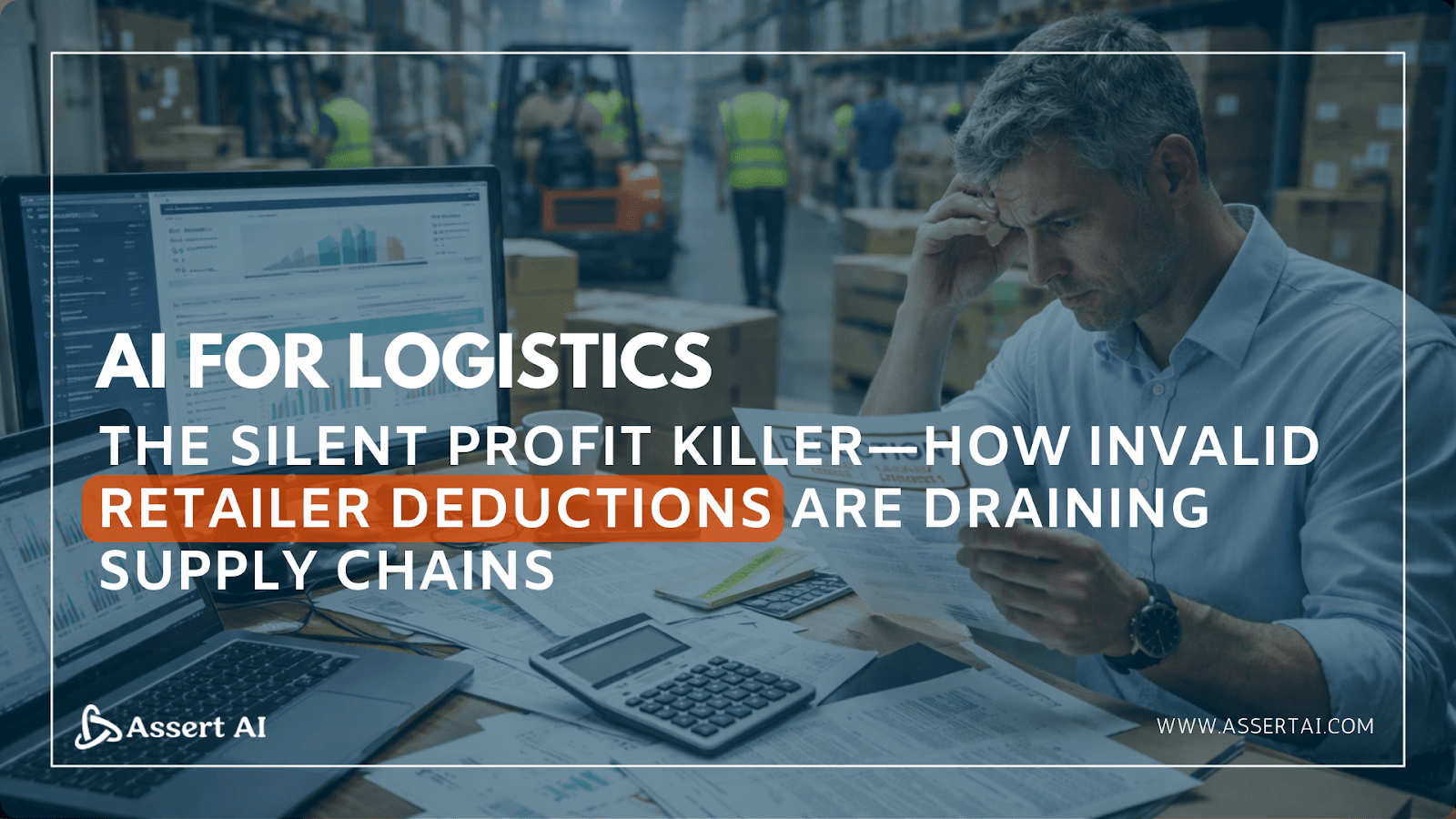
AI for logistics is rapidly becoming essential as retailer deductions supply chains confront a growing but often overlooked problem invalid retailer deductions. For years, deductions and chargebacks have been quietly accepted as part of retail partnerships, often dismissed as unavoidable friction. But the reality is far more damaging.
These deductions are not just operational noise; they represent systematic revenue leakage. Every shortage claim, compliance penalty, or mismatch deduction chips away at margins, often without validation and frequently without resistance. A Chief Financial Officer from a global consumer durables company captured this shift in mindset clearly: “We spent decades accepting deductions as a cost of doing business. Now we understand they’re actually the cost of doing business poorly.”
This “poorly” does not refer to execution alone, but to the lack of visibility, proof, and control across the supply chain. What companies are truly paying for is not error but the inability to prove accuracy.
The Real Cost of Deductions: How Much Revenue Is Quietly Lost?

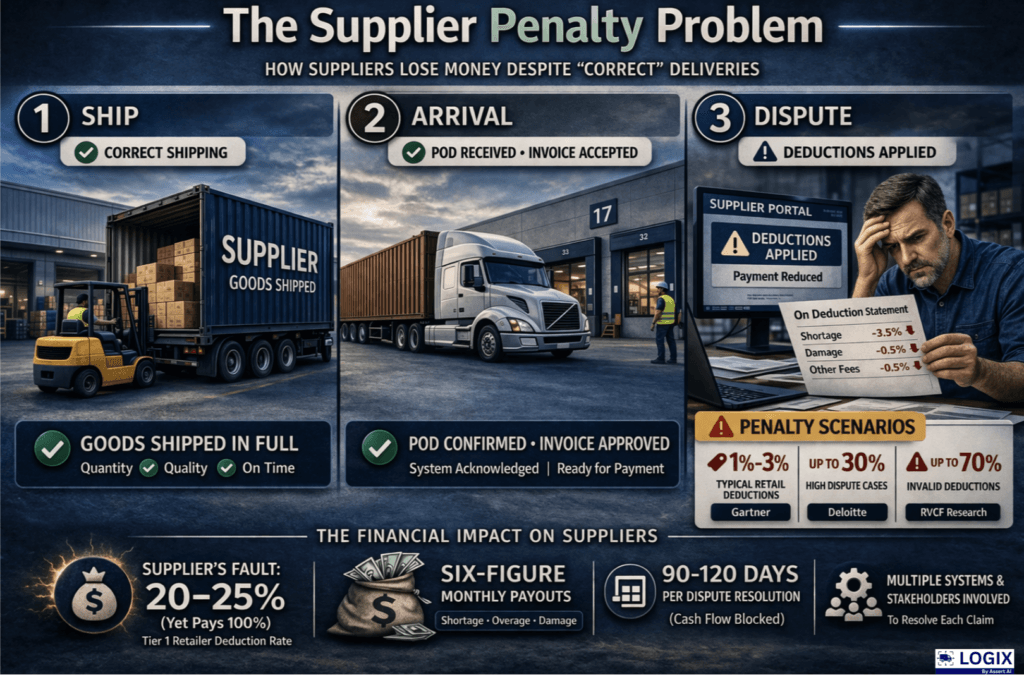
Retail compliance frameworks like OTIF (On-Time In-Full) were designed to bring structure to supplier performance, but they have also introduced significant financial exposure. What appears as standard compliance enforcement often translates into measurable revenue erosion.
Industry data highlights the scale of the problem. Retail penalties typically range between 1% to 3% of invoice value, according to Gartner. However, in some supplier-retailer relationships, total deductions can climb as high as 30% of invoice value, as reported by Deloitte. Even more concerning, research from the Retail Value Chain Federation (RVCF) suggests that up to 70% of deductions may be invalid.
Despite these numbers, companies continue to absorb losses. Suppliers often estimate that they are responsible for only 20–25% of discrepancies, yet they still incur six-figure monthly payouts due to shortage, overage, and damage claims. The gap is clear: the issue is not just operational accuracy it is the absence of verifiable proof.
The Hidden Cost: Time, Teams, and Operational Drag
The financial impact of deductions is only part of the story. The operational burden they create is equally significant and often underestimated.
Resolving retail deductions is a slow and resource-intensive process. For large retailers, a single dispute cycle can extend up to 90–120 days, requiring coordination across multiple systems and stakeholders. Teams must navigate retailer portals, reconcile shipment and invoice data, gather fragmented documentation, and manually build dispute cases.
As a result, many organizations dedicate entire teams solely to deduction management. Yet even with this effort, outcomes remain inconsistent. The process does not scale efficiently, and success rates depend heavily on the quality of available evidence. What should be a straightforward validation exercise becomes an ongoing operational drain.
Why Suppliers Lose Even When They’re Right
At the core of the problem is a structural imbalance in how deductions are issued and resolved. Retailers operate at scale and often lack granular visibility into inbound discrepancies. To compensate, deductions are applied broadly, placing the burden of proof entirely on suppliers.
This creates a one-sided dynamic where suppliers must prove their correctness rather than expect it to be assumed. As one North American retail executive put it, “If you’re not helping us make the shelf profitable, we’ll find someone who will.”
The challenge is further compounded by the limitations of traditional shipment records. Most distribution centers rely on barcode scans, ERP logs, Bills of Lading, and carrier weight tickets. While these systems confirm that processes were followed, they fail to capture what physically happened at the dock.
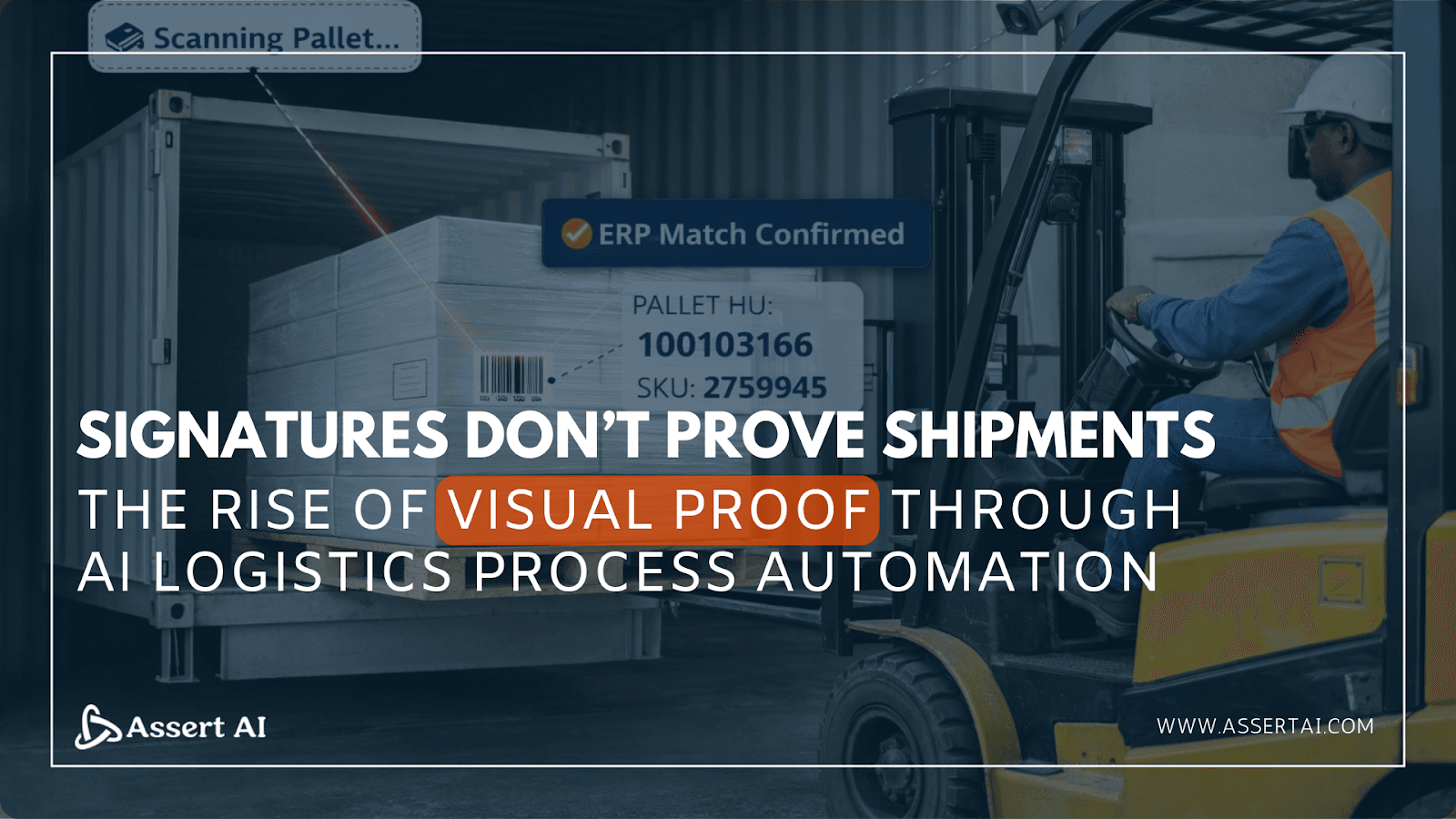
Also Read: Signatures Don’t Prove Shipments
A barcode scan shows that an item was processed, not that it was actually shipped. A Bill of Lading confirms dispatch, but not exact contents. Weight-based validation provides estimates, not SKU-level accuracy. When discrepancies occur whether during transit or at the retailer’s receiving end suppliers lack the evidence needed to defend their position. As a result, they absorb the loss.
From Blind Spots to Proof: The Shift Enabled by AI for Logistics
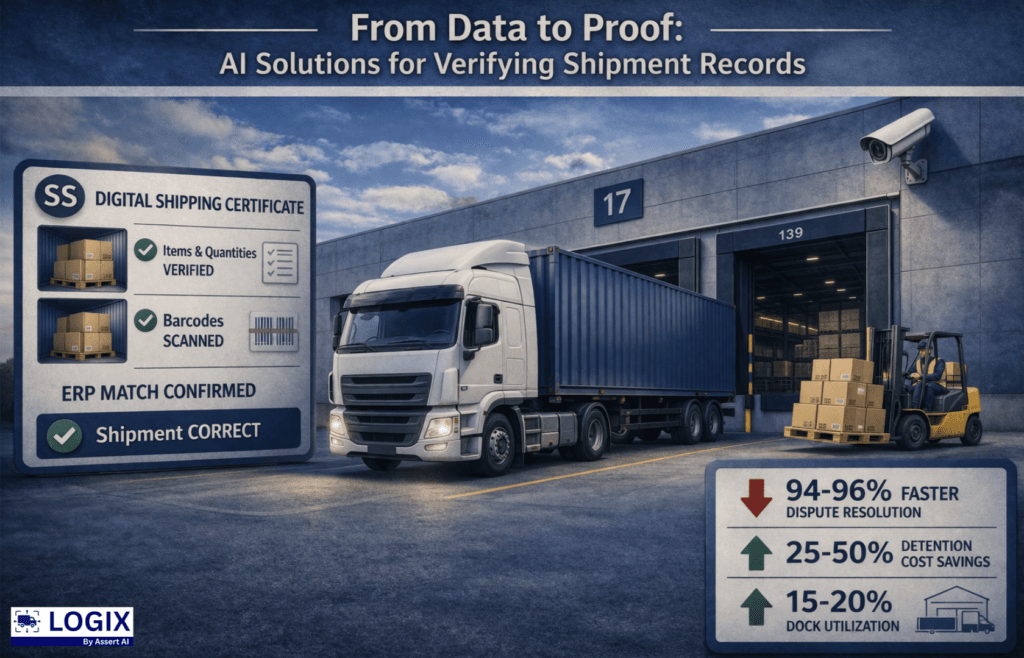
This is where AI for logistics is driving a fundamental shift in how supply chains manage deductions. Instead of reacting to claims after they occur, organizations are moving toward real-time shipment verification.
Modern warehouse logistics solutions are evolving beyond tracking and planning into execution-level validation. By integrating computer vision in logistics, companies can monitor dock operations continuously, capturing every movement and matching it against ERP data in real time.
These computer vision logistics systems create a new standard of visibility, one that goes beyond transactional records to establish factual, visual proof of execution. The focus is no longer on documenting processes, but on verifying outcomes.
From Data to Proof: Building a Verifiable Shipment Record
With the help of logistics process automation AI, companies can now generate structured, audit-ready shipment records that combine transactional data with visual evidence. Every dispatch event is recorded with time-stamped context, creating a unified and reliable record of what actually left the facility.
This concept, often referred to as a Visual Shipping Certificate, represents a significant advancement in supply chain validation. Instead of piecing together fragmented documents during a dispute, companies can present a single, cohesive record that clearly demonstrates shipment accuracy.
This shift transforms the entire dispute process. Conversations with retailers move from assumption to evidence, from negotiation to verification. The ability to prove what was shipped changes the balance of power.
The Business Impact: Faster Recovery and Stronger Margins
Organizations adopting AI for logistics, along with computer vision in logistics, are seeing measurable improvements across both financial and operational metrics. Dispute recovery rates can reach up to 97%, while resolution times are reduced by 94–96%. At the same time, reliance on manual processes decreases significantly, improving efficiency across teams.
More importantly, the impact is strategic. Finance teams gain greater predictability in receivables, operations teams achieve stronger execution control, and leadership teams no longer accept revenue leakage as inevitable. Warehouse logistics solutions powered by computer vision logistics are turning supply chains into defensible revenue systems rather than reactive cost centers.
Stop Paying for What You Can’t Prove
Retailer deductions are not going away. If anything, they will continue to increase as retailers optimize their margins and enforce stricter compliance standards. The real question is whether suppliers will continue to absorb these costs or evolve to address them.
By adopting logistics process automation AI and computer vision in logistics, companies can eliminate ambiguity, establish proof, and protect their margins. The shift is not just technological, it is strategic. Solutions like LOGIX by Assert AI are already enabling this shift by bringing real-time, verifiable proof into everyday shipping operations.
Because in modern supply chains, the rule is simple:
what you can’t prove, you pay for and what you can prove, you keep.