Why Drive-Thru Performance Determines QSR Success
The modern quick-service restaurant isn’t defined by its dining room anymore, it’s defined by the speed and precision of its drive-thru. Whether it’s morning commuters rushing for coffee or late-night diners looking for convenience, customers expect fast, frictionless service without compromise. One slow lane, one delayed order, or one inaccurate handoff can instantly impact the customer experience and ultimately, the store’s revenue.
As competition intensifies and guest expectations rise, QSR brands can no longer depend on guesswork, manual timing, or outdated sensors to understand what’s happening in their drive-thru. Real-time operational intelligence has become the new competitive edge. This is why leading brands are rapidly turning to QSR drive-thru monitoring AI, elevating everyday cameras into powerful tools for real-time restaurant monitoring and performance optimisation.
This blog breaks down how AI and computer vision for QSR drive-thru are transforming operational decision-making unlocking faster service, actionable insights, and scalable consistency across locations.
What Is QSR Drive-Thru Monitoring AI?
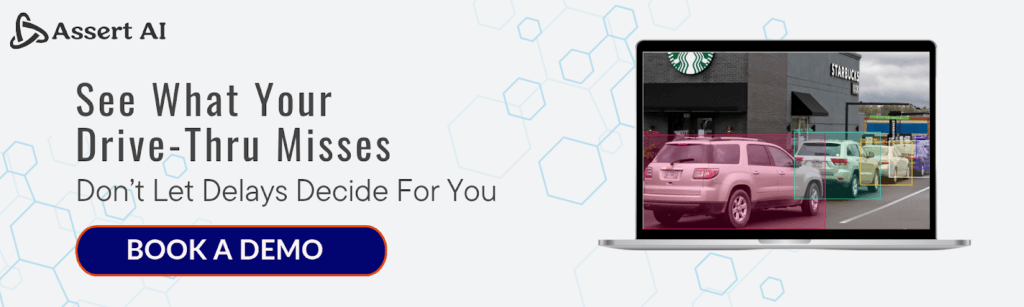
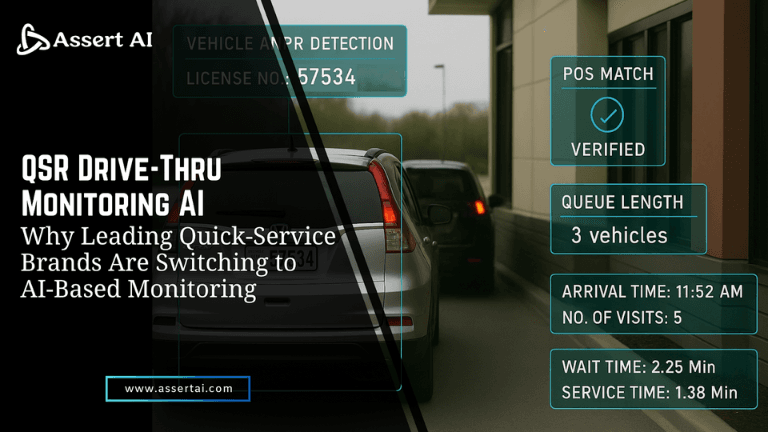
QSR drive-thru monitoring AI is an automated system that uses cameras and artificial intelligence to track, analyse, and improve drive-thru performance. Instead of relying on manual timing or basic sensors, AI continuously evaluates what’s happening in the drive-thru lane in real time.
Here’s a simple breakdown:
- Cameras capture live video of the drive-thru area.
- Computer vision for QSR drive-thru detects vehicles, maps their movement, and understands each stage from entry to order placement to the pickup window.
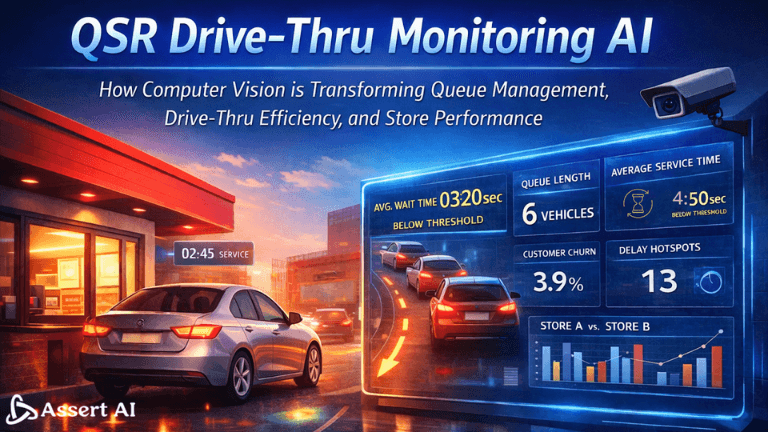
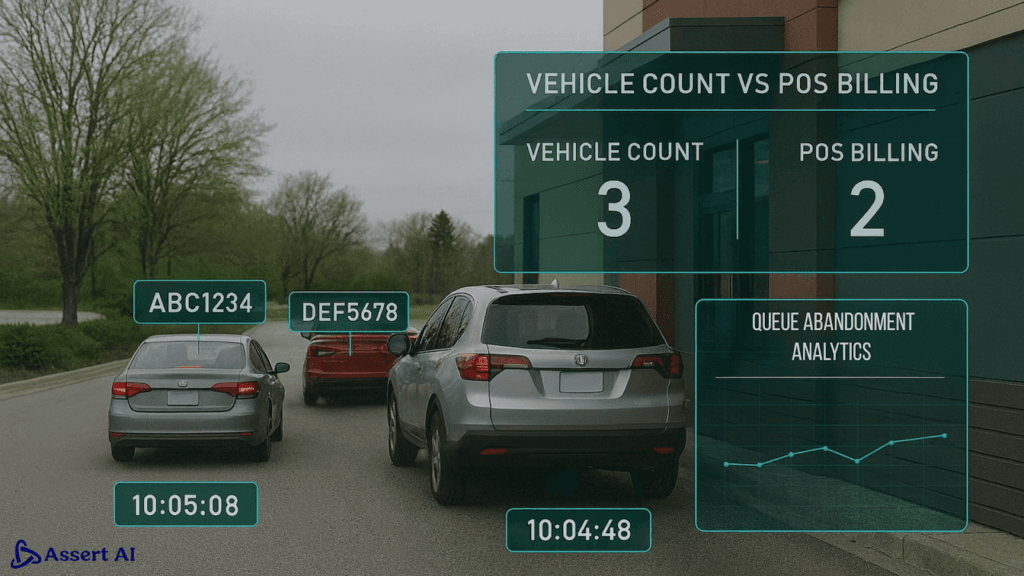
- AI calculates exact wait times, vehicle counts, queue lengths, and service delays.
- A web-based dashboard displays the full picture to operators, managers, and area leaders and integrates with SMS, Whatsapp and push notifications for real-time alerts.
Users don’t need technical expertise. The system works seamlessly in the background, making it ideal for QSR operators, franchise owners, store managers, area coaches and operational excellence teams.
Because it is delivered as AI SaaS for QSR monitoring, the system is scalable, easy to deploy, and accessible even for multi-store brands with limited IT resources.
Why Traditional Drive-Thru Monitoring Falls Short
Anyone who manages a drive-thru knows how quickly things get chaotic during peak hours. Cars stack up, customers get impatient, the team rushes, and it becomes harder to understand what’s really happening in the lane. The standard explanation becomes “it’s rush hour”, and the industry has learned to accept this chaos as normal.
The truth is simple:
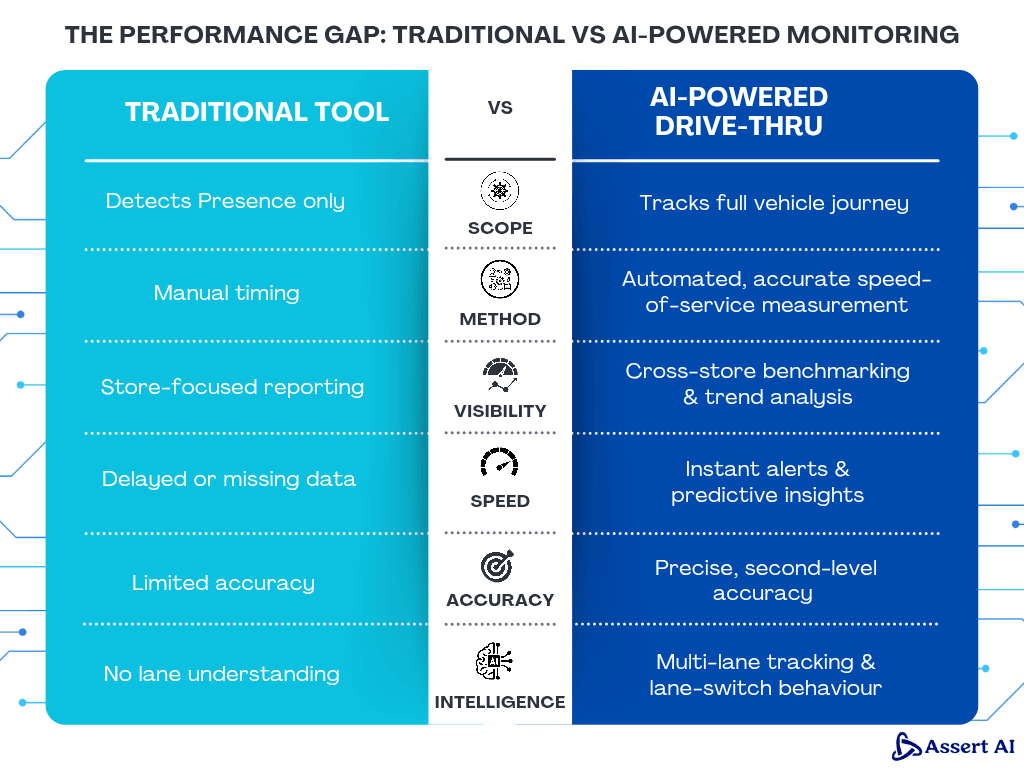
Most traditional monitoring tools weren’t built for today’s reality. They can’t keep up with double lanes, delivery drivers, mobile orders, or the growing pressure to serve customers faster than ever.
Limitations of Conventional Monitoring Systems
1. Manual Timing
Many stores still rely on a stopwatch or clipboard, but this breaks down the moment rush hours hit. Managers can’t time vehicles while handling customers and coaching staff, so timings get skipped or filled in from memory. The result is inconsistent data that never reflects the real drive-thru experience customers face outside.
2. Simple Loop Detectors
Loop detectors only indicate that a vehicle is present, not what the vehicle is doing. They can’t tell how long cars wait, if lanes are switching, or why slowdowns occur. In multi-lane drive-thrus, they often misread traffic and leave operators guessing where queues form or what truly slows throughput limiting their usefulness for real performance improvement.
3. POS Timestamps
POS timestamps capture when an order is entered inside into the POS system, but not how long customers wait before reaching the menu board. A store may think its service is fast based on POS data, while customers outside are spending extra minutes just getting to the order point. This disconnect leads to decisions made on partial data, leaving real bottlenecks hidden.
4. Inconsistent Human Reporting
Manual reporting varies widely by team and shift. During busy hours, logs often go undone or are completed later with estimates. Different managers record data differently, making it hard to trust reports as accurate measures of performance. Inconsistent reporting turns what should be objective data into guesswork, limiting meaningful improvement.
Why Do Operators Need AI Today?
QSR environments have evolved dramatically yet most monitoring tools haven’t. In today’s QSRs, things have changed a lot. The drive-thru, once just another service window, now brings in 60–70% of the sales, and that pressure has pushed restaurants into multi-lane setups that are harder to manage by human eye. During peak hours, cars pile up, lanes get confusing, and delivery drivers keep coming in with their own urgency, adding to the rush.
At the same time, customers expect their orders to be faster and more accurate than ever, while operators deal with fewer staff and constantly changing teams. Everything moves so quickly that traditional monitoring just can’t keep pace anymore making AI the support operators need right now.
Without full visibility, operators can’t answer critical questions.
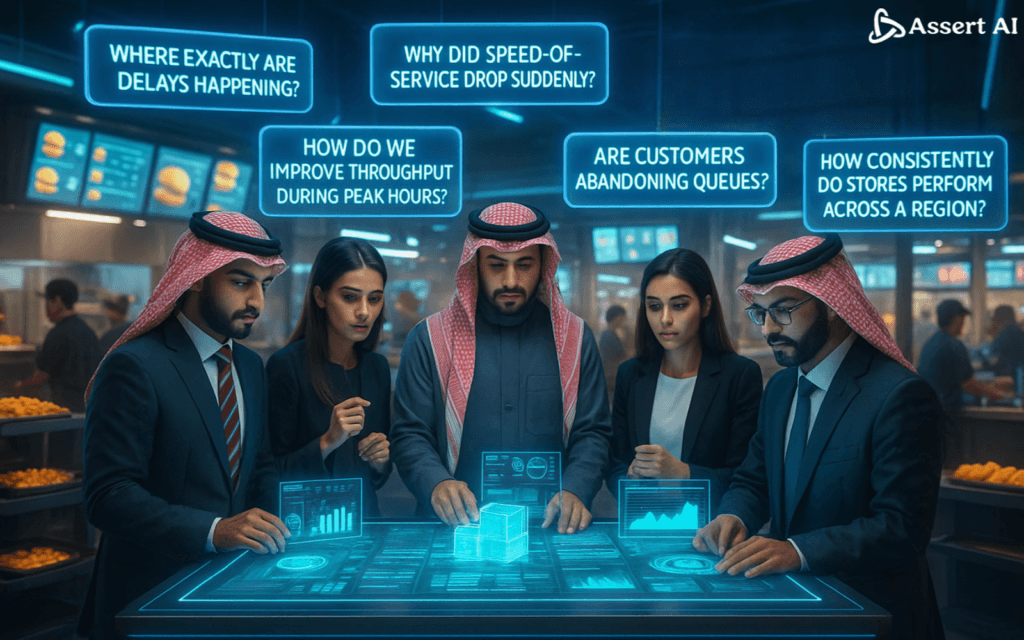
With QSR drive-thru monitoring AI, operators gain continuous, objective, data-rich insights unlocking a level of operational intelligence impossible through traditional tools. This shift is why leading QSR brands are replacing outdated systems with AI-driven visibility and automation.
How Modern Drive-Thru Monitoring AI Works
Modern drive-thru monitoring AI works by turning live video into real-time operational intelligence. Instead of relying on manual checks or outdated timers, the system automatically detects every vehicle, tracks its journey across lanes, timestamps each stage, and measures key performance metrics with high accuracy. Operators get instant insights and alerts, helping them spot delays, manage queues, and improve speed of service effortlessly.

Core Features of QSR Drive-Thru Monitoring AI
Modern AI platforms offer a rich ecosystem of capabilities. Key features include:
Real-Time Queue Detection
The system shows exactly how many cars are waiting at any moment. This helps staff take action before the line gets too long.
Accurate Wait-Time Calculation
Track how long each car waits, from entry to exit. This gives operators true timings not samples, not estimates, but the real numbers customers experience.
Order Progress + Bottleneck Identification
If the menu board is slowing down, if the handoff window is stuck, or if the kitchen is taking too long, get notification immediately. Managers can fix the exact point causing the delay.
Predictive Alerts
Instead of reacting to problems, the store gets notified early when the AI sees patterns of increasing delay.
Multi-Lane Tracking
Perfect for dual or triple lanes. AI understands lane switching, lane speed, and how cars move in complex layouts.
POS, KDS & Loyalty Integration
This gives a complete picture of how orders move from customer → kitchen → window → exit. Operators finally understand the full journey.
Every Camera Becomes a Sensor
AI uses the cameras you already have. No need for new hardware. This lowers cost and makes rollout faster.
Unique Capabilities that Distinguish Modern AI from Competitor Tools
Modern drive-thru AI goes far beyond timers and basic vehicle counters. These advanced capabilities give operators a deeper, more actionable understanding of performance across lanes, stores, and dayparts.
- Cross-Camera Vehicle Re-Identification
Recognise and follow the same vehicle across multiple camera views, allowing accurate end-to-end journey mapping even in complex, multi-lane layouts.
- AI-Based Speed-of-Service Benchmarking
Comparing performance across stores, regions, and time periods with standardised metrics help brands identify top performers, lagging sites, and recurring bottlenecks.
- Advanced Multi-Lane Intelligence
Interpret lane-switching behaviour, lane speed differences, queue distribution, and throughput insights essential for optimising dual or triple-lane drive-thrus.
- Monitoring Beyond the Drive-Thru Lane
Modern systems extend analytics to parking lots, curbside pickup, walk-in entrances, and delivery-driver zones, offering a full restaurant visibility platform not just a drive-thru timer.
- High-Value Business Intelligence Using Existing Cameras
By converting standard CCTV cameras into analytical sensors, operators gain detailed operational intelligence without costly hardware upgrades.
Integration: How AI SaaS Connects With Existing QSR Systems
Modern drive-thru AI is designed for fast, low-effort adoption. Operators don’t need to rebuild their tech stack; the system simply layers on top of existing hardware and software.
- CCTV Infrastructure
AI connects directly to the restaurant’s current camera network. Most QSRs can start using AI insights without installing new cameras, making this one of the easiest integrations. The system simply streams video from existing CCTV into the AI engine, instantly turning every camera into an intelligent sensor.
- POS & Drive-Thru Timer Systems
By aligning AI timestamps with POS order times and drive-thru timers, operators get a complete view of the customer journey, not just when the order was keyed in. The integration also helps POS teams identify repeat customers, access last orders and favourites for smarter upselling, verify that every vehicle matches a billed transaction, and ensure no car in the lane goes unaccounted for.
- Kitchen Display Systems
AI insights from the drive-thru lane can sync with kitchen display systems(KDS) activity to show how kitchen speed impacts lane throughput. When queues grow or certain menu items slow down service, the system helps teams prioritise production and staffing more effectively.
- Intuitive Dashboards
AI plugs into existing reporting tools or corporate dashboards, allowing operators to view real-time performance trends alongside other store KPIs. This creates a unified operational view without changing current reporting workflows.
Plug-and-Play SaaS With Minimal Hardware Upgrades
Because the platform operates as SaaS, deployment is quick, often requiring no more than connecting camera streams and granting API access to POS or reporting tools. Operators get powerful analytics with AI SaaS for QSR monitoring without expensive hardware, sensors, or complex rewiring.
Edge vs. Cloud Processing Options
Edge AI: Processing happens locally on a small on-site device. Best for low latency and stores with strict data policies.
Cloud AI: Analytics run in the cloud, ideal for multi-store brands that want centralised dashboards, remote updates, and easy scaling.
Brands can choose the option that best fits their IT, compliance, and operational needs.
Cost Breakdown: Understanding QSR Drive-Thru Monitoring AI Cost
QSR drive-thru monitoring AI cost varies based on the scale and complexity of each restaurant, but the true value lies in its impact faster throughput, stronger customer satisfaction, improved accuracy, and measurable revenue uplift. Instead of focusing on the price alone, brands should evaluate how AI-driven visibility and automation reshape operational performance with real-time restaurant monitoring.
Key Factors That Influence AI Cost
1. Number of Cameras Required
Costs vary depending on how many camera inputs are needed to cover the drive-thru entry, menu board, order window, and pickup lane.
2. Level of Analytics Chosen
Stores may opt for basic monitoring, advanced queue intelligence, predictive analytics, multi-store benchmarking, or even active process control; each tier influencing pricing significantly.
3. Cloud vs. Edge Processing
Cloud-based processing offers easy scaling, while edge devices provide low-latency, on-site computation. Different deployment models affect overall cost.
4. Multi-Location Deployment
Large chains benefit from enterprise pricing, tiered packages, and volume discounts, especially when rolling out AI across multiple regions or cities.
5. Custom Integrations
Integration with POS systems, KDS platforms, loyalty tools, or reporting dashboards may involve setup and engineering costs, depending on the restaurant’s tech environment.
Typical Pricing Models for Drive-Thru Optimisation Solutions
Based on industry standards and the structure, here is a refined breakdown:
1. Subscription-Based Pricing
Most drive-thru AI solutions use a per-store subscription model, with pricing adjusted based on camera counts, lane complexity, and required analytics.
2. Per-Lane Pricing
Ideal for multi-lane restaurants. Each lane single, dual, or triple is billed individually, reflecting the different monitoring and analytics load.
3. Per-Location Enterprise Plans
Enterprise chains can choose tiered packages that scale easily across multiple stores. These plans often combine basic monitoring, advanced intelligence like queue prediction and benchmarking, ANPR-based repeat customer insights, and centralised dashboards for managing performance across all locations.
4. Usage-Based Pricing
Some brands prefer paying based on the volume of processed video hours (operational hours of a store), detected events, or traffic load ideal for stores with fluctuating demand.
5. One-Time Implementation & Integration Fees
Fees may apply for onboarding, POS/KDS integration, system calibration, or edge hardware installation (if needed). These are typically one-off setup costs.
6. Volume-Based Discounts for Chains
Companies like Assert AI offer reduced pricing for multi-city or multi-country deployments, enabling large brands to scale without inflating operational costs.
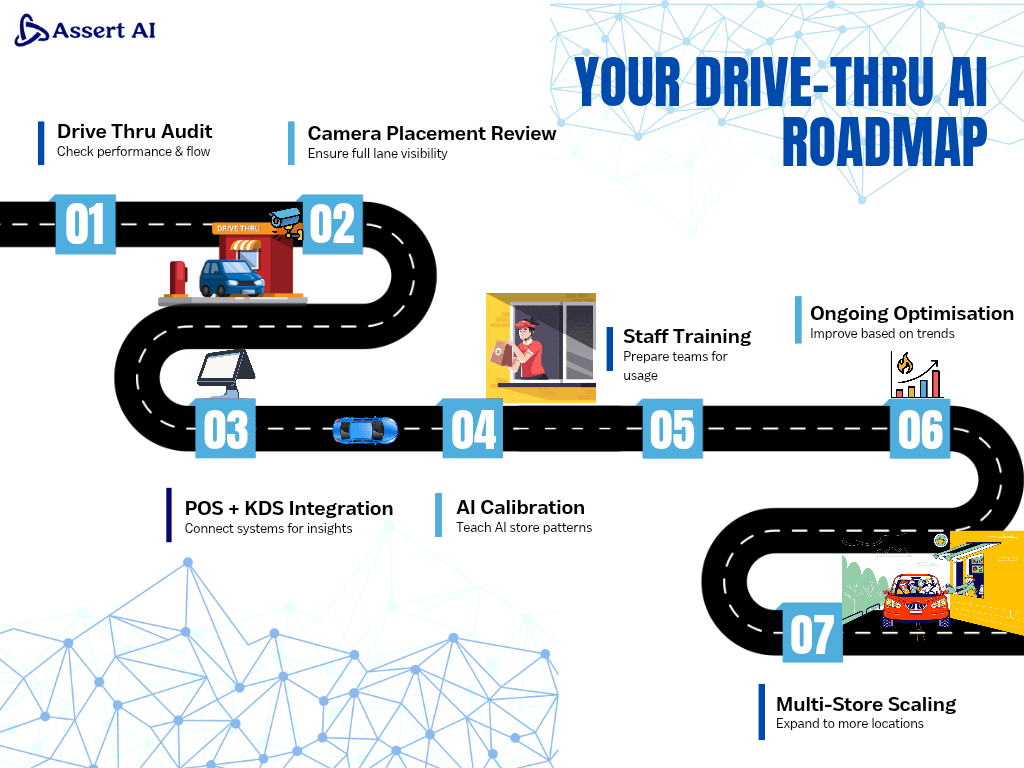
Step-by-Step Implementation Roadmap for QSR Operators
Implementing drive-thru AI becomes much easier when operators follow a clear roadmap. These seven steps outline how QSRs can move from assessment to full-scale adoption while ensuring smooth deployment, accuracy, and team readiness. This roadmap ensures each store gains consistent results and long-term operational improvements.
Compliance, Privacy, and Ethical Considerations
Data privacy is a major priority for every modern QSR, especially when AI and video analytics are involved. Drive-thru AI systems are designed with strong privacy controls so operators can use valuable insights without compromising customer trust.
- Anonymisation of Vehicle and Face Data
AI automatically masks number plates and facial features before any analysis is done. This means the system works with anonymised data by default, ensuring no personally identifiable information is stored unless absolutely required. Any temporary footage used for calibration or incident review is kept only for a short period and deleted automatically once it’s no longer needed.
- Strict Compliance With Local and Global Regulations
Whether the store operates in the UAE, KSA, Europe, USA, or any regulated region, the AI solution follows local privacy laws and CCTV guidelines. Operators can configure where data is stored (edge devices or cloud), how long it is retained, and who has access to it. All video feeds and analytics are encrypted both in transit and at rest, and access is limited through role-based permissions.
- Optional Facial Recognition With Responsible Use
Facial recognition for Drive-Thru analytics is never enabled by default. It is used only in specific, approved scenarios such as when a client wants to analyse customer movement patterns, dwell time, or repeat visits on foot. Even then, Assert AI does not perform face identification. Faces are filtered, not stored, and all associated data is automatically deleted within 30 minutes. Activation requires explicit client approval, transparent communication, and full adherence to all applicable data protection and privacy regulations in the respective country or region.
Future of Drive-Thru: What AI Will Enable in the Next 3–5 Years
AI’s role will continue to expand dramatically. Expect:
- Predictive Staffing
AI will forecast rush periods using patterns, events, and weather trends. Stores will schedule crews proactively instead of reacting to queues.
- AI-Assisted Kitchen Sequencing
Kitchen prep will sync automatically with real-time drive-thru flow. AI will prioritise orders based on congestion and complexity.
- Fully Automated Lanes
AI-driven ordering, payment, and queue control will power near-staffless lanes. These lanes will offer consistent speed even during labour shortages.
- Vision + Voice AI Fusion
Computer vision will analyse lane movement while voice AI manages ordering. Together, they will create faster, error-free, conversational drive-thru experiences.
- Personalised Loyalty Menus
With customer consent, AI will recognise loyalty users or app arrivals. Menu boards will adapt in real time to show favourites or personalised offers.
- Virtual Lanes for Digital Orders
AI will manage mobile and curbside orders in invisible “virtual queues.” Digital pickups will be sequenced without disrupting physical lane traffic.
- Smart Forecasting With External Signals
Future systems will combine weather, traffic, and local events to predict demand. Operators will adjust staffing and prep long before rushes hit.
Why Choose Assert AI for QSR Drive-Thru Monitoring AI?
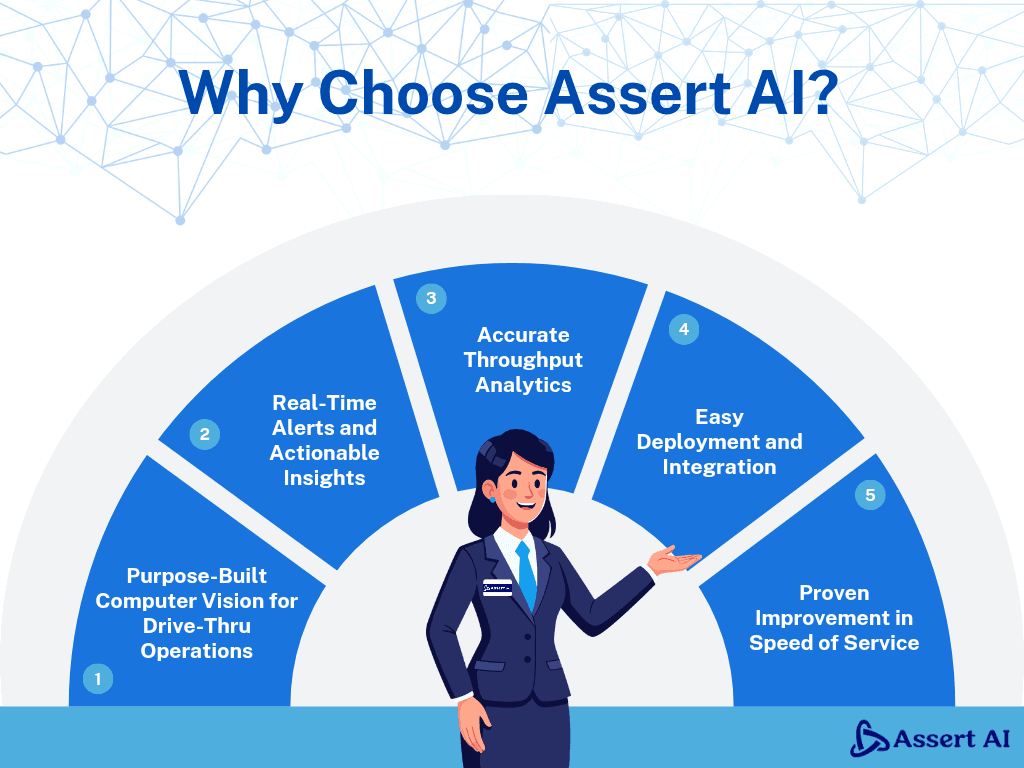
Assert AI gives QSRs the clarity they’ve been missing in the drive-thru. Instead of guessing where delays happen, operators get real, actionable visibility into every stage of the customer journey. It works with your existing cameras, sends instant alerts, and highlights bottlenecks before they turn into customer complaints. With proven results across multiple locations, Assert AI helps you run a smoother, faster, and more consistent drive-thru making it the smart choice for any brand ready to level up performance.
Operational Wins with Assert AI
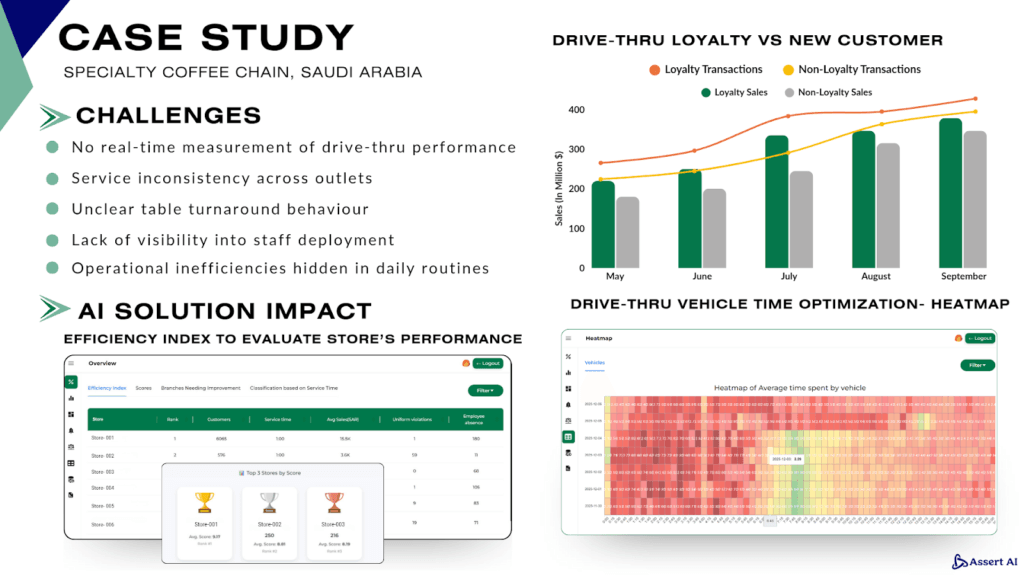
Case Study – Specialty Coffee Chain, Saudi Arabia (Name Withheld)
Client Overview
A fast-growing Saudi Arabian specialty coffee brand with 170+ outlets, including 80+ company-operated drive-thru lanes, multiple walk-ins, and a wide franchise network. High customer velocity across formats demands consistent service speed and operational discipline.
Challenges
- No real-time measurement of drive-thru performance: Actual wait times, order handover delays, and queue buildup remained invisible, affecting customer experience.
- Service inconsistency across outlets: Without standardised metrics, comparing drive-thru vs dine-in performance was subjective and slow.
- Unclear table turnaround behaviour: Busy dine-in formats struggled to understand how seating delays impacted customer throughput.
- Lack of visibility into staff deployment: No automated way to detect absentee or unmanned service counters during peak hours.
- Operational inefficiencies hidden in daily routines: Errors in order handling, latency at service points, and workflow gaps increased both cost and customer dissatisfaction.
Impact Created by Assert AI Vision based Monitoring Solution
- Existing customer identification- loyalty vs non-loyalty sales, loyalty vs non-loyalty transactions.
- Network-wide service visibility through real-time flow analytics, queue detection, and timestamp-based performance scoring.
- Detection of a 4% POS order mismatch rate, mapped to specific outlets, enabling data-backed SOP corrections.
- Improved drive-thru wait times and order cycle duration using automated measurement of arrival-to-exit timestamps.
- Faster table turnaround in dine-in zones, driven by occupancy duration tracking and idle-table detection.
- Higher staff responsiveness with live monitoring of counter presence and service-point activity.
- Consistent service delivery across regions via standardised KPIs for drive-thru, dine-in, and franchise operations.
The future of drive-thru operations is intelligent, automated, and data-driven. QSR drive-thru monitoring AI empowers restaurant brands to improve speed of service, increase throughput, boost accuracy, and deliver a consistently better customer experience every hour of the day.
With real-time visibility, predictive analytics, seamless integration, and scalable deployment, AI is no longer a luxury for QSRs, it’s a necessity.
Restaurants that adopt AI SaaS for QSR monitoring today will lead the next decade of operational innovation.
Every second lost in your drive-thru is a customer you may never win back.
Assert AI helps you uncover delays, boost throughput, and transform your operational consistency.
See the difference for yourself. Book a demo now.