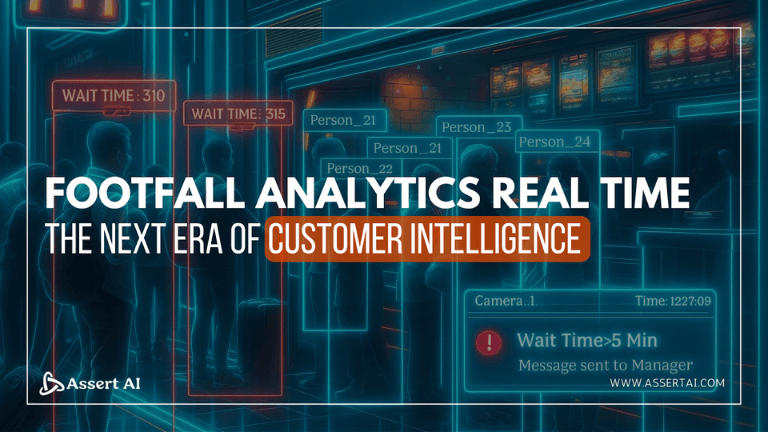
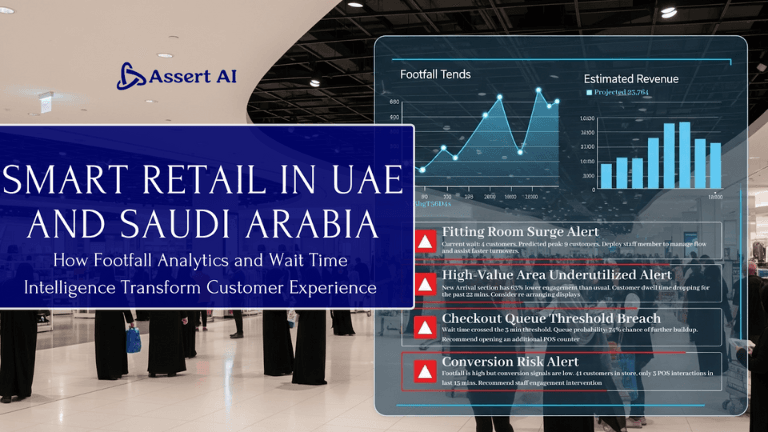
Footfall analytics real-time gives businesses clear visibility into visitor behaviour, engagement, and staff performance. By tracking key KPIs such as total footfall, dwell time, and peak-hour patterns, brands can optimise operations and improve customer experience. This blog explores how real-time intelligence is transforming retail, showrooms, QSRs, events, and public spaces supported by a real deployment case showing measurable improvements in flow and engagement.
WHY VISITOR BEHAVIOUR IS NOW A BUSINESS MANDATE
Customers today have endless choices, and they naturally gravitate toward experiences that feel effortless and engaging. For organisations, this makes understanding visitor behaviour a fundamental business requirement.
Footfall analytics in real time gives leaders instant clarity replacing assumptions with data and eliminating delays from manual reporting.
It helps businesses answer the essentials:
What truly captures visitor attention?
Where does movement slow down or queues form?
When does footfall peak during the day?
How long do visitors stay and interact?
How effectively is staff responding on the floor?
With these insights, organisations can redesign layouts, deploy staff intelligently, elevate service quality, and improve conversions with confidence.
This is the intelligence every modern business needs to perform at its best.
THE REAL CHALLENGES YOU MAY ALREADY BE FACING IN YOUR BUSINESS
Before exploring how to improve your operations, it’s important to reflect on what may already be happening inside your store, showroom, exhibition booth, mall, QSR, or any high-footfall environment you manage. If you read through the points below and find yourself nodding, you’re not alone. These are exactly the challenges most businesses face every day.

1. No Clarity on True Visitor Volume
If you’re relying on manual checks, approximations, or outdated sensors, you may already feel the gap between what you think your visitor count is and what it actually is. This uncertainty makes planning and forecasting extremely difficult.
2. No Visibility Into What Customers Actually Do
Do they go left or right? Do they explore your key products or walk past them? Where do they pause?
If you don’t have clear answers to these questions, you’re likely making decisions based on guesses rather than actual visitor behaviour.
3. Difficulty Identifying real prospects
Teams cannot differentiate serious customers from casual passersby. And because of that, your team may miss high-intent visitors while unknowingly spending time on low-intent ones. This directly affects conversions and customer experience.
4. Inefficient Staff Deployment Times
You’ve probably seen this in your own operations:
Some hours feel overstaffed, while others feel chaotic. Without knowing exactly when your customer rushes happen, efficient staff planning becomes almost impossible.
5. Inability to Measure Visitor Engagement
Maybe you’ve invested in certain layouts, signage, or product placements but you still can’t confidently say which parts of your space drive real engagement and which ones are being ignored.
This leads to repeated trial and error, costing time and money.
6. Poor Space Utilisation and High Operational Costs
If you feel that certain areas of your store or showroom are “dead zones,” but you don’t have data to justify redesigning them, you’re likely paying for space that isn’t delivering value.
7. Delayed or Inaccurate Reporting
Weekly or monthly summaries don’t help you fix today’s problems.
If you’ve ever found an issue only after a report reached your desk, you know how much opportunity gets lost in the meantime.
8. Unmanaged Crowding and Queue Drop-Offs
If you find out about long queues because staff or customers report it verbally, you’re already late. Every minute of unmanaged crowding increases irritation and walk-aways.
WHY FOOTFALL ANALYTICS MATTERS
THE BUSINESS BENEFITS YOU GET
1. Create Experiences That Matter
Understanding where visitors spend time helps you focus your efforts where it truly impacts sales and satisfaction.
2. Improve Conversion Without Increasing Costs
Knowing which zones work and which don’t allows you to optimise displays, layouts, and product placement without large investments.
3. Align Your Operations With Real Customer Demand
Peak hour insights help in planning staff schedules, marketing activities, and service deployment precisely when customers need it.
4. Take the Guesswork Out of Decision-Making
Every decision becomes data-backed from visual merchandising to event scheduling to resource allocation.
5. Deliver Faster and Better Service
Staff performance insights help reduce customer wait time, and ensure every visitor receives timely support, especially during rush periods.
6. Maximise Every Square Foot
Dwell time patterns reveal which areas drive value and which require strategic changes boosting ROI per square foot.
Footfall analytics shifts organisations from “we think” to “we know”, and that clarity is a competitive advantage on its own.

Data-Backed Impact: What the Industry Is Achieving Today
Recent industry numbers highlight how computer vision-driven footfall analytics is transforming physical retail and experiential environments:
- Stores using real-time footfall analytics have recorded up to a 40% improvement in layout optimisation, reduced customer wait time, enabling smarter product placement and higher engagement.
- Customer satisfaction scores have increased by nearly 30% through CV-based dwell-time and service-speed analysis, helping brands optimise staffing during peak footfall windows.
- Businesses adopting footfall-trend forecasting have seen over 45% better accuracyin planning promotions, staff capacity, and inventory, driving more predictable performance.

HOW DIFFERENT INDUSTRIES TURN FOOTFALL INTO REAL BUSINESS VALUE
Every industry has people walking in, walking around, comparing, waiting, exploring and exiting but the impact of these movements is very different depending on your business model.
Below is a more immersive view of how footfall intelligence touches each sector. As you read, imagine these scenarios unfolding in your own space.
Retail: When Every Step Your Customer Takes Is a Signal
Think of the moment a shopper enters your store. Their movement tells you everything: what caught their eye, what they compared, where they lost interest, and what ultimately made them decide.
Footfall intelligence becomes the invisible layer that decodes all these signals and helps you:
- Spot the exact shelves people slow down at
- Identify where conversion drops occur
- Understand why queues form at certain times and area
- Deploy staff only where attention is needed
Retailers use AI powered dwell time analysis and insights to design smarter store layouts, reduce dead zones, and turn browsers into prospects.

Automotive Showrooms: When Serious Buyers Must Never Be Missed
Every walk-in could be a potential buyer planning a long-term purchase. The thin wall between a sale and a missed opportunity is timing.
With footfall patterns, dealerships can:
- Identify peak intent hours
- Distinguish real buyers from casual visitors
- Ensure sales staff never misses a high-intent window
- Gauge interest in specific models in real time
You’re not guessing what excites your customers, you’re witnessing it through how they navigate your showroom.

QSR & F&B: Where Every Minute a Customer Waits Feels Longer Than It Should
What if you are able to see your queues forming before they reach the counter. Or knowing exactly which time slots consistently lead to lost orders because customers give up waiting.
Footfall insights help QSRs:
- Anticipate rush periods
- Optimise staff rotations
- Reduce walk-aways
- Increase throughput during peak hours
This is how restaurants turn fast-moving crowds into fast-moving revenue, while also enhancing customer experience.

Exhibitions & Events: Where Attention Is Your Currency
Every exhibition space is a competition who attracts the most visitors, who retains them longest, and who truly engages them.
By interpreting footfall behaviour, exhibitors can:
- See which zones pull the most attention
- Identify drop-offs during demos
- Redesign booth flows on the fly
- Measure ROI of each display element
You no longer wait till the event ends to know what worked. You adapt while the crowd is still in front of you.
Why This Matters for You
Every decision inside a physical space becomes more strategic when you understand how people move within it.
Whether you’re selling products, serving meals, showcasing machinery, hosting visitors, or managing high-density environments, footfall intelligence becomes the backbone of how you increase revenue, improve efficiency, and boost customer satisfaction.
CASE STUDY — HIGH-FOOTFALL AUTOMOTIVE SHOWCASE
About the Client
The client is a well-known global automobile brand that frequently showcases its latest car models through open public events across major malls and high-footfall venues.
The Client’s Challenge
- Heavy investment in mall activations without clear visibility into actual showcase footfall.
- No accurate understanding of which car models were attracting genuine visitor interest.
- Lack of measurable insights on how long visitors stayed at the exhibition and how deeply they engaged.
- No clarity on peak enquiry periods or high-traffic time windows.
- Limited visibility into staff responsiveness and overall visitor service quality.
- Reliance on manual observation that was inconsistent, delayed, and frequently inaccurate.
What They Received After Deployment
- Real-time visibility into total footfall, segmented into prospects, engagers, and bounce-offs.
- Engagement comparison across all showcased models, including zone-wise visit counts and time-spent brackets.
- Dwell-time insights by zone to understand visitor interest depth and quality of interactions.
- Peak activity analysis, highlighting peak day, peak hour windows, and average visit volumes for optimized staff allocation.
- Gender split and geographic origin analytics to better profile visitor demographics.
- Heatmaps and zone performance insights for smarter vehicle placement and display optimization.
- Instant crowd build-up alerts to manage floor congestion and enhance visitor flow.
- Clear identification of visitor intent. From prospects to engagers to bounce-offs, enabling sharper lead qualification.

What Sets Our Platform Apart
1. Designed for Decision-Makers, Not Just Analysts
The platform transforms complex camera inputs into simple, actionable insights that business teams can immediately act on without technical training or dashboards that feel overwhelming.
2. Built to Adapt to Your Space, Not the Other Way Around
Whether it’s a compact retail kiosk, a multi-level showroom, or a high-traffic mall event, the platform configures itself to your operational reality, eliminating the need for structural changes or expensive hardware overhauls.
3. Intelligence That Grows With Your Business
The more your footfall increases, the more refined the system becomes. Patterns get sharper, predictions more accurate, and operational recommendations more aligned with your long-term business goals.
4. Enterprise-Grade Reliability Without Enterprise Complexity
You get consistency, speed, and precision at scale but with an experience designed to be easy, fast, and adoption-friendly across departments.
5. A Future-Proof Ecosystem
As your needs evolve from engagement mapping to queue intelligence to crowd management the system evolves with you, ensuring your investment keeps delivering value for years.
Driving Your Space Toward What’s Next
The way people move inside your space already tells you everything you need to know; you simply need a smarter, clearer way to see it. When visitor behaviour becomes visible, understandable, and actionable, your business becomes more efficient, more profitable, and more customer-focused than ever before.
Ready to turn every footstep into meaningful business growth? Let’s build your next intelligent space together.